Friday, May 27, 2016

Some Random Thoughts of an Aam Aadmi


After joining public life towards the end of February this year, I
shared some of my impressions in these columns as a new recruit in politics under the banner of the Aam Aadmi Party (AAP). I am a humble volunteer or a worker of the AAP and as such write this from my personal perspective as a student of this game called politics.

The AAP is a new political party born out of a movement against corruption. The agenda and the vision of the party is to remove corruption, establish grass-root democracy (Swaraj), transparency in administration, social empowerment with bottom to top approach to bring about transformation and change i.e. Parivartan (systemic change).  These lofty ideas appealed to me, as I wrote earlier also, and I joined the AAP to make my humble contribution towards that much needed and visualized Parivartan.

Unlike the other political parties, I have found that the AAP does not project new entrants as leaders but make them work as volunteers and workers. Some of them may become leaders but it would happen through the process only. The observers appointed by the central leadership in Delhi work with the local coordinators to carry forward the agenda of the party and to look after the organizational aspects. The volunteers and workers are advised and directed by the observers and coordinators with regard to the activities of the party. Being an Aam Aadmi and an ordinary member of the party, I have been following the directions and conducting myself accordingly with regard to the party activities as a dedicated student. I think my total involvement will get registered.

Public contact is one of the important aspects of public and political life.  I remained in this business but from a different perspective as a faceless diplomat. By now, I have realized that in politics, it is done in a different fashion. One needs to be pushy and noisy. One needs to be visibly vocal and loud mouthed. One needs to be artificially humble. Let us see, how best I adjust myself to these requirements. Some of my friends advise me to throw myself into the thickness, if I want to succeed in politics. I have seen some of my fellow workers in the party, who aspire to be leaders and party candidates in the forthcoming elections in Punjab, know these unwritten rules of the game quite well. These slogan shouting, loud mouthed leaders engage some non-descript, uneducated and gullible young fellows, whom I term “Bhade Ke Tattoo”, and create scenes at public meetings. I don’t know how the party leadership views them but I despise and dislike them. The AAP is a party with a difference and we are to prove it. Let us develop some good political culture and precedents so that good people, sober people, considerate and thinking people could come and join politics for the greater good of the polity and society. Let us bring some dignity and decorum to the game of politics. Apart from numerous nukkad meetings in the area (Jalandhar West), I have had opportunities to speak briefly at the AAP Jan Sabha at Basti Guzan, Ambedkar Jayanti celebrations at Desh Bhagat Yadgar Hall and the AAP volunteers meeting at Victoria Gardens. It was a unique experience. As a diplomat, I was used to deliver both structured and impromptu
speeches on different occasions without any hassle. The juniors like me are made to rush and finish. The loud mouthed, referred to above, are apt in presenting and keeping themselves on the mic whereas the protocol conscience and disciplined fellows like me find it difficult and succumb to the dictates of the stage managers. Another problem is the timing and schedule of functions and engagements. We tend to pass this as a joke ‘Indian standard time’ rather than showing any inclination to maintain the time and schedule. As a result, most of the time, I claim the honour to be the first at least in this exercise as I could not manage to be the first in other substantive aspects of life. Some consolation! My party managers advised me informally that I should try to register and increase my presence at public functions. I tend to accept and honour their advice, but it is difficult to imbibe the culture of pushing around and elbow out the friends of my own political clan. Nevertheless, I am determined to survive and prevail.

The AAP is a transparent, democratic and an open party. The manifesto for the forthcoming elections in Punjab is under study and formulation under the newly devised dispensation called “Punjab Dialogue”. The experts are meeting the cross sections of the society to elicit their views on various subjects and matters of concern and interest. They are yet to come to Jalandhar where I reside. But on my own, I have already made suo motto, suggestions and observations for consideration particularly with regard to some of the issues pertaining to a sizeable, about 32% in Punjab and around 40% in some of the constituencies in the Doaba region, dalit community. The dalit community will play an important role in the politics of Punjab.

I would tend to be an active and result oriented fellow in public life
under the flag of the AAP. In the process of learning the tricks of the game, I am open to any suggestion and advice from my friends, well wishers, supporters and above all my party observers, coordinators and managers. I recall some lines of Hindi poetry:

मैं नहीं सन्देश स्वर्ग का लाया,

इस भूतल को ही स्वर्ग बनाने आया !

Friday, April 22, 2016

Guru Ravidass Memorial at Khuralgarh


There is a poetic saying”Kuffar Toota Khuda Khuda Karke”. The
Punjab government has finally woken up to recognize and respect Guru Ravidassji by building a memorial at Khuralgarh, a site at Garhshankar in Hoshiarpur district of Punjab. It is believed that Guru Ravidassji visited and stayed at Khuralgarh which was then a princely state of one of the close relations of Mira Bai who herself was an ardent spiritual follower of the great Guru. This historical fact has been confirmed and authenticated by the concerned governmental authorities on the initiative of a community activist Banta Ram Ghera. There are two sites – one in Khuralgarh village where Guru Ravidassji stayed and meditated and second at the foothill where Guru Ravidass struck water with the toe of his foot on the request of the villagers. That place, since then, is called ‘Charan Choh Ganga’. Obviously, Khuralgarh has become a historical pilgrimage for the millions of followers of Guru Ravidass both in India and abroad. Thousands of faithful followers visit Khuralgarh daily to pay their obeisance to their Guru. The picturesque place is increasingly becoming a tourist attraction in the region, in spite of the fact that there is hardly any development of the needed infrastructure and civic amenities created and extended by the government authorities. The two sites, that is, the Gurudwara at the village Khuralgarh and the Charan Choh Ganga are manned and managed by two separate private trusts. There is no consultation and cooperation between these trusts rather, as I gathered during my recent maiden visit to Khuralgarh, they are fighting with each other and also other vested interests who intend to gain control of these holy sites. The authorities have been silent spectators resulting in criminal neglect and no development and care of the important historical inheritance of the millions of followers of Guru Ravidassji.

The central government, on the initiative of then Minister Ambika Soni, identified Khuralgarh as a tourist destination some years ago. A tourist guest house was built but it was of no use. In the absence of matching infrastructure like approach road and other amenities, this guest house is almost an abandoned building, as I could see myself.

The Punjab government, at the time of last elections about four years ago, with a view to woo dalit votes, showed interest in Khuralgarh. But it was only an election plank. The momentary enthusiasm died its natural death. I wrote to the Culture Secretary sometime in 2013 and offered my services to do something concrete and positive for the Khuralgarh plan. He referred my humble offer to the then Minister Sarwan Singh. As I did not have any political back up, my offer could not find favour with the honourable Minister. The Akali-BJP coalition government did not do anything on the Khuralgarh project. Now the elections are fast approaching. Khuralgarh has again occupied the attention of the government to encash their cheque on the vote bank of the followers of Guru Ravidassji. The seasonal birds have surfaced again with their love for the great guru and spiritual well being of his followers. A grand plan to build a state of the art Guru Ravidass memorial at Khuralgarh, at the cost of 110 crores of rupees, has again been put on the drawing board. At the foundation laying ceremony on April 3, 2016, CM Parkash Singh Badal said “As a tribute to Guru Ravidass, it will be an architectural marvel with a
congregation hall for 10,000, a modern auditorium for an audience of 500 and 151 feet high Minar-e-Begumpura.” The purpose of the memorial is said to establish ‘a sacred place associated with Guru Ravidassji as a world class centre to propagate the message of divinity, communal harmony, peace, universal brotherhood and compassion’. The importance of Guru Ravidass and his followers has appeared in the psyche of the government once again. That is why I said “Kuffar Toota Khuda Khuda Karke”. Let us see how much is done at Khuralgarh before the election. After that the drawing board will be shifted to some junk store to gather dust till the next elections.

All the major players in the great political game are busy in wooing the dalits to gain their support and votes. In the process, they are undertaking and employing all the tricks and tactics not that there is any love lost or they are interested in improving their position or empowering them as equals but only to befool them to get their votes. This is the 10th year of the Akali-BJP government in Punjab, maybe the final year before they are thrown out by the upcoming political forces like the AAP. What have they done for the dalits?  Dalit icons Guru Ravidassji and Dr. B.R. Ambedkar have suddenly appeared on their radar. Have they budgeted any definite amount to be spent on the Khuralgarh project? Have they fixed any timeline to complete the project? Have they put in place any special outfit to see the execution of the 110 crore Khuralgarh project? What special programme have they made to celebrate and observe the 125th birth anniversary of the greatest son of India, Dr. B.R. Ambedkar? I wrote to the Deputy CM of Punjab on the subject some months ago but there was not even an acknowledgement.  Again surprisingly, I read a story in the Hindustan Times that MOS Vijay Sampla has mooted a proposal to make a world class memorial of Dr. B.R. Ambedkar at Bootan Mandi, the so called capital of dalits. I, a humble Bootan Mandian, welcome the proposal. But I am certain that the proposal will remain a news item only.  I will write on this subject separately.


My dear dalit brethren, kindly watch out for the emerging scenario and marshal your forces to safeguard your interests in this great game otherwise you will again be cheated.

Thursday, April 14, 2016

Babasaheb Ambedkar – The Greatest Son of India

Today, April 14, we are celebrating the 125th birth anniversary of
Babasaheb Dr. B.R. Ambedkar (April 14, 1891 – December 6, 1956), the greatest son of India in the contemporary times. I greet my fellow citizens of India and supporters of democracy, justice, equality, liberty and fraternity, the values which were dear to Babasaheb, in the world at large. It is a matter of gratification to note that not only the government of India but also several other authorities, the world over, including the UN are celebrating and observing the day in one way or the other to pay a fulsome homage to the great man of our times. It has been noted with a lot of satisfaction tha
t in spite of all social odds, political challenges and personal problems which Babasaheb faced throughout his life, his persona received more and more attention and recognition every passing day and more so after his death. By now, it seems, there is hardly anybody in the entire political, social, intellectual and academic circles of not only India but of the world at large who does not hold him in high esteem and recognize him as an intellectual giant, a constitutional expert, an economist, a statesman, a social reformer, a humanist, a spiritual flag bearer of the great Gautam Buddha. Dr. Ambedkar was a unique phenomena and a legendary figure of contemporary times. Mahatma Gandhi who was one of the staunch critics and opponent of Dr.Ambedkar said long back, sometime in the early 1930s, “You may criticize Dr. Ambedkar but you cannot ignore him.”  I am sure that the importance, significance and relevance of Dr. Ambedkar are bound to increase in the years to come. What could be a better tribute to the memory of the greatest son of India?

It is a matter of great dismay that Dr. Ambedkar did not get his due in his lifetime either from the political establishment or from the people of India at large. Dr. Ambedkar was a stout critic of the Congress Party and as such PM Jawaharlal Nehru and his colleagues like Babu Jagjivan Ram, D. Sanjivaya, inter alia, saw to it that he was sidelined from the thickness of political and even the social playing field. The upper caste dominated intelligentsia also did not take much notice of him. He was condemned and projected as a defeated leader of a section of the dalit communities as late as the 1970s. But it was not to be. Dr. Ambedkar was an ardent nationalist, an intellectual par excellence, a humanist of the highest order, a spiritual leader of the Buddhist heritage. How can such a personality be ignored for long. The wonders of democracy started getting visible, the edifice of which was set up by Babasaheb himself in the constitution and polity of India. The dalits, the backwards, the neglected and marginalized sections of the society started asserting themselves. The resultant social and economic empowerment of the weaker sections of the society including women changed the political scenario drastically. The relevance of Dr. Ambedkar surfaced and surfaced with such intensity that it became difficult to ignore him anymore. Now the situation has emerged that all political parties are vying among themselves to own the legacy of the greatest son of India. The think tanks and academia not only in India but also abroad has re-evaluated and recognized the sterling role played and the contribution made by Dr. Ambedkar in shaping the constitutional, economic, social and spiritual landscape of India for the benefit of the marginalized humanity the world over.  The leading universities and academic institutions including the Columbia University of the US and the Cambridge University of the UK  besides the Indian academic outfits have increasingly honoured and recognized, and rightly so, Dr. B.R. Ambedkar. The print and electronic media has taken a due notice of him and have come up with special issues and programmes on Dr. Ambedkar.  –  Der Ayat; Darust Ayat. It is a befitting tribute to the memory of the legendry personality of Dr. Ambedkar.

The successive governments in India, after independence, did not pay much attention to Dr. Ambedkar and willfully kept him on the margins except the fact that he was given an onerous task of making the constitution of India. It was a challenge which he accepted knowing full well that it was not an easy job. In spite of his failing health and several problems created by his political and social adversaries, he did his best and gave us a fine document to run a country full of contradictions, diversity and graded social inequalities. The constitution has stood the test of times over the years since its adoption on January 26, 1950. India is now not only a vibrant and the biggest democracy of the world but also a respected member of the comity of nations. It is a matter of satisfaction that the 125th birth anniversary of Dr. B.R. Ambedkar
is being celebrated at the UN in New York with all gusto and sobriety. I am happy to state that,  as a humble follower of Babasaheb Ambedkar, I wrote to EAM Sushma Swaraj and PM Narendra Modi in August last year to make a demarche to the UN General Assembly to declare April 14, the birthday of Dr. Ambedkar, as the International Day of Equality. The proposal was duly acknowledged but did not find acceptance. I am confident that the stock of Dr. Ambedkar is bound to rise up and up in the years to come and the suggested honour will be bestowed on him in due course.  The sooner the better.

PM Narendra Modi’s government, due to its electoral compulsions, is trying to appropriate the legacy of Dr. Ambedkar. During the year of 125th birth anniversary of the great leader, the government has come out with many projects and memorials to celebrate the greatest son of India. It must be appreciated. But we need not limit ourselves to tokenism alone. The life, mission and legacy of Dr. B.R. Ambedkar should be included appropriately in school and university curriculum for the benefit of the coming generations. The dalit communities consider Dr. Ambedkar next to god. There is no doubt about it. The political and intellectual elite are increasingly accepting and realizing the importance and relevance of Dr. Ambedkar.  But I note with regret that the casteist mind set of the upper caste society at large is yet to accept and own him. This is a ground reality which cannot be ignored all together.  It will be difficult till the Manuwadi mindset and unequal social order are altered and overthrown. I think it will be done by no one except the larger than life persona of Ambedkar himself, if India has to remain the India visualized by our fore-fathers including Babasaheb Ambedkar himself.  The governments, the political parties, the media, the intellectual elite are celebrating Dr. Ambedkar on his 125th birth anniversary but the public participation seems to be limited to dalits alone. Why should it be so? The only answer to this big question which comes to my mind is that it is due to historical reasons of Manuwadi mindset and caste based social order. Dr. Ambedkar himself said that democracy would have no meaning without establishing a casteless society.
The legacy of Dr. B.R. Ambedkar is such a potent force that it will take its own care in the years to follow as it has happened so far. The emerging political scenario appears to be of concern and worry. Consciously or otherwise, Lal Salam is getting acquainted with Jai Bheem.  If these forces join hands, it will prove to be a force to reckon with. One must not forget that Dr. Ambedkar compared Gautam Buddha and Karl Marx and said their ultimate goal was the same that is removal of ‘Dukkha’and ‘Exploitation’ but the methods suggested and adopted were different.  He said that the communist system was based on force and Buddha followed a democratic system and added that ‘Buddha’s method was the safest and soundest’.  Over the years, the Marxists, the Communists and other Leftist outfits have adopted democratic and peaceful methods to pursue their agenda to end exploitation. These methods are akin to the Buddhist thinking. In simple words, Lal Salam and Jai Bheem, as recently demonstrated at, inter alia, Hyderabad University, Jawaharlal Nehru University, Jadhavpur University, may become slogans of the younger generation particularly that of the depressed and suppressed segments of the society. We must understand it to ward of the untoward. We stand by Dr. Ambedkar for a peaceful and democratic revolution.

I conclude this with an important quote from Dr. Ambedkar to rededicate ourselves to the peaceful methods to save our hard earned independence and for further progress and prosperity of India. He said on November 25, 1949 while delivering his last speech in the Constituent Assembly before the Constitution was finally adopted and passed, “If we wish to maintain democracy not merely in form, but also in fact, what must we do? The first thing in my judgement we must do is to hold fast to constitutional methods of achieving our social and economic objectives. It means we must abandon the bloody methods of revolution. It means that we must abandon the method of civil disobedience, non-cooperation and satyagraha. When there was no way left for constitutional methods for achieving economic and social objectives, there was a great deal of justification for unconstitutional methods. But where constitutional methods are open, there can be no justification for these unconstitutional methods. These methods are nothing but the grammar of anarchy and the sooner they are abandoned, the better for us.”

A poetic tribute to Babasaheb Ambedkar in the words of a renowned poet Gurdas Ram Alam:

ਲੂਹ ਕੇ ਸਿਮਰਿਤੀ ਨਵਾਂ ਵਿਧਾਨ ਲਿਖਯਾ;
ਅੱਗ ਲਾ ਕੇ ਸਾਗਰਾਂ ਦੇ ਪਨਿਆਂ ਤੇ,
ਰਾਸ਼ਤੇ ਹਿੰਦ ਦੇ ਨਵੈ ਉਲੀਕ ਦਿਤੇ;
ਪੈਰ ਫੇਰ ਕੇ ਲੀਹਾਂ ਪੁਰਾਣਿਆ ਤੇ !


Wednesday, April 6, 2016

Some Random Thoughts – AAP Jan Sabhas in Punjab

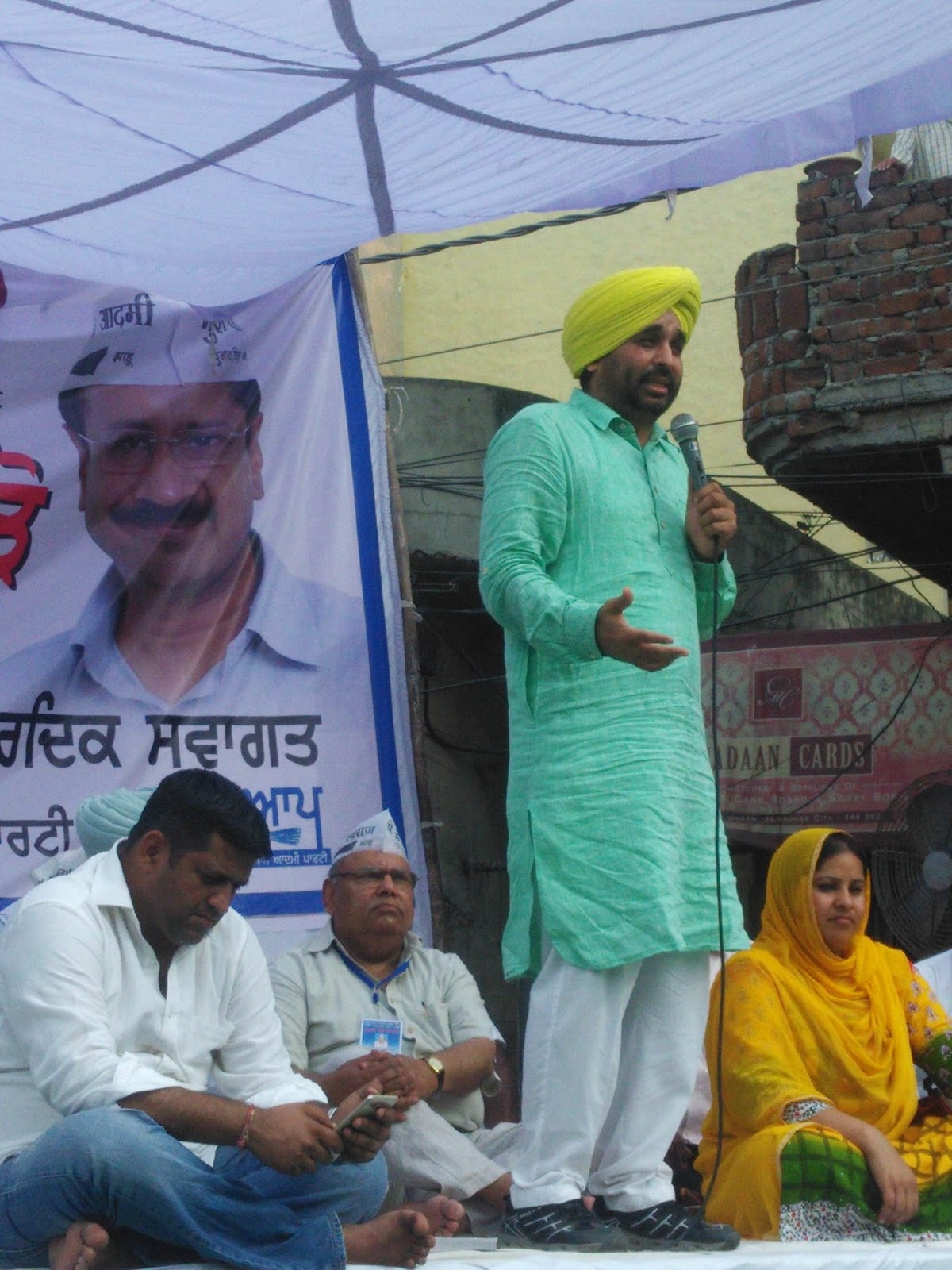
MP Bhagwant Mann addressing the Sabha

The Aam Aadmi Party (AAP) has arrived in Punjab and it is destined to reach at the first opportunity available in the timeline of the forthcoming elections in Punjab in early 2017. The recently held Jan Sabhas in all the three regions, Majha, Malwa and Doaba, have clearly indicated the mood of the people and have confirmed the findings of the surveys and opinion polls conducted by the expert agencies. People are for change as they stand fed up of the ruling Akali-BJP elite and equally of the runners up and the so called alternative, the Congress Party. Both these groups have lost the confidence and support of the people of Punjab at large. The AAP leadership under the stewardship of Arvind Kejriwal is fully charged and involved in bringing about the much needed ‘Parivartan’ as visualized by our leader Arvind Kejriwal. Through these well organized and attended Jan Sabhas, MPs Bhagwant Mann and Sadhu Singh supported and accompanied by, inter alia, Convener of the AAP in Punjab Sucha Singh Chhottepur, Central Observer Sanjay Singh, star campaigners like Gurpreet Ghuggi, Sukhpal Singh Khaira, Santokh Singh Salana and others have raised the curtain of the upcoming events and scenario on the political firmament of Punjab in the coming months. It seems that Punjab is all set for almost a clean sweep by the AAP.

I am also a small cog in the AAP wheel. I contributed my humble
Ramesh Chander adressing the Sabha
bit to the Jan Sabha on April 3 at Basti Guzan on advice and consultation with our political guides, Rajiv Chaudhary, Dr. H.S. Cheema and Sunil Dutt. It is a matter of satisfaction that the Sabha, which was addressed by MP Bhagwant Mann and Santokh Singh Salana, was a great success. The audience listened to the AAP leaders with rapt attention and interest. I was also invited to speak briefly at the Sabha. It was my first speech from a political platform after joining the AAP in the last week of February, 2016. After living a 35 years long career of a faceless diplomat, it was a new but pleasant experience. I was full of emotions. I had my schooling in the area at the Sain Dass School at Basti Nau. I used to roam around in shorts and knickers in Basti Guzan for cost effective stationery and old books from the make shift ‘Kishoo di Hatti’ located under the huge and old banyan tree at the big round about near the Adda Basti Guzan, the venue of the Jan Sabha. After my education, I enjoyed and relished the fruits of Indian Foreign Service (IFS), one of the coveted services of India. Now from the same venue, I was starting my political life to serve the people and society to pay back the debt of gratitude, I owe to them. I could not control myself and expressed my feelings in a charged and choked voice at the Sabha. I am confident that I will get the due public support in the noble task.

With this, I rededicate myself to work hard under the banner of the AAP to realize the vision of our leader Arvind Kejriwal to give power to the people to transform our political democracy into socio-economic democracy as visualized and stipulated by our fore fathers, particularly my idle and icon Babasaheb Dr. B.R. Ambedkar.

यह राहें ले ही जांएगी, मंजिल तक, हौसला रख;

कभी सुना है ? अँधेरे ने सवेरा होने दिया !

Tuesday, March 29, 2016

Some Random Thoughts of a Novice


After due consideration, I joined the Aam Aadmi Party (AAP) about a month ago. I am new in this game. I joined the AAP on the premise that it was a party with a difference. I thought the new
party i.e. the AAP will provide a desired place and space to well meaning people to join hands to work for much needed development and well-being of the common man of the country through good administration and governance. It is gratifying to note that the AAP and its volunteers, workers and supporters are fully involved and dedicated to meet the challenges and deliver to the benefit and advantage of the Aam Aadmi. Let us wish them all success in the years to come.

My first impression of political life is that it is not an easy job. No one promotes anyone but oneself. One has to create space for
oneself by pushing others. Most of the slogan-shouting politicians are not necessarily committed and even knowledgeable.  To remain visible and in the news is yet another trait which the politicians tend to cultivate with an added zeal.  One has to be thick skinned to survive in public life. I am reminded of an anecdote from the autobiography of EAM K. Natwar Singh when PM Indira Gandhi advised him, in a lighter vein, at his joining the public life, to become thick skinned rather than changing to khadi attire. These are some of my random thoughts at this initial stage. I have joined politics with a clear conviction to serve the society, particularly the weaker sections, honestly and diligently. I want to be a politician with a difference as my party AAP rightly claims to be a party with a difference. Though I am yet to know and interact with the bosses and leadership at the higher echelons of the party yet, at the functional level, I have found all of them very cooperative and accommodative. The AAP volunteers are the real force and are the backbone of the party. I am open to listen and learn in the process.
With regard to my diplomatic background, let me refer to the traditional definition of a diplomat which says ‘a diplomat is a person who is sent to another country to tell lies about his country.’ But frankly, throughout my diplomatic career, I did not believe in this dictum. I tried and did my best to be truthful and sincere not only in my personal dealings but also in my work and performance as a diplomatic representative of my great country. I learnt from the experience and guidance of my diplomatic gurus like President K.R. Narayanan, Vice President Hamid Ansari, Foreign Secretary S. Jaishankar and followed Foreign Secretary T.N. Kaul’s assertions in his book “Ambassadors need not lie”.  Similarly in politics and public life, I would tend to negate the often repeated assertion that politics is a dirty game. I will tend to support that gentlemen should join politics with noble intensions to clean the system by using the Jhadoo (Broom) of the AAP.

I solicit all round support and encouragement in this task.


Tuesday, March 1, 2016

Some Random Thoughts - On Joining the AAP


I remained a faceless diplomat for more than 35 years before my retirement from IFS in December, 2010. I decided in the beginning of 2003 to come back from Delhi to my roots in Jalandhar with a view to integrate myself with the community and repay the debt of
Ambassador Ramesh Chander speaking at DAV College, Jalandhar
gratitude I owe to the society in a humble way. In the process of my settling down, I chose to associate with the education sector to begin with. Sant Baba Bhag Singh University was gracious enough to nominate me on its Board of Governors.  I ventured to start an educational outfit – Jalandhar School of Careers and Opportunities to benefit the children of my native place Bootan Mandi and nearby localities. Given my background and interest, Doordarshan Jalandhar provided me a window to reach out to the wider audiences through its various programmes to which they invite me occasionally. Some of the leading schools and colleges in and around Jalandhar associated me with their activities and invited me to speak at various functions. I associated myself with the community functions, particularly pertaining to Dr. B.R. Ambedkar and Guru Ravidassji, to satisfy my social yearnings. These activities kept me busy as my post retirement engagement which, in a lighter vein, I termed as my ‘Second Innings'.

Some of my friends and also my immediate family, my brothers and sisters, have been suggesting me to join public life and share my wide experience with the society. But I remained reluctant because of my perceived temperament and training. Would I be able to withstand the dust and din of politics? Would I be able to go thick skinned, said to be an important attribute of a politician? Do I have the needed ‘killing instinct’ which a politician generally uses to deal with his adversaries? The increasing role of money, with my own scarce finances, in politics always remained a concern with me. But as an enlightened citizen, I remained fully live and informed of the changing political scenario, of late. Over the last three years or so, the Aam Aadmi Party (AAP) under the leadership
of Arvind Kejriwal has thrown open some new avenues and opportunities on the political firmament of the country. It started from the core issue of corruption which has eaten the vitals of the polity and society at large. The AAP opted for clean and transparent politics. It negated the VIP culture from which the common man on the road was suffering. It supports and pleads for social justice, as enshrined in the constitution, for empowerment of the weaker sections of the society. Above all, the AAP stands for power to the people as stipulated in the preamble of the constitution with a view to establish ‘Swaraj’ and an egalitarian society. I thought, perhaps, the time has become. The AAP, a party with a difference, appealed to me. It has come but is yet to reach. I seriously pondered over all these points. Meanwhile, my well wishers have been cajoling me to take a plunge into politics and join the AAP, an emerging party on the political landscape of India. Sometime in January, 2016, I did not tell anybody and enrolled myself online and became a member of the AAP. I sent an E-mail message to the Convener of the AAP, Arvind Kejriwal and to the Central Observer, Sanjay Singh and solicited their advice on making my joining the party public at an appropriate occasion and requested for an introductory and courtesy call on them during their next visit to Jalandhar. I waited for a response for a couple of weeks. There was no response which worried me a bit as I was sure that the AAP would respond and behave differently. In the second week of February, 2016, I took the liberty of writing again and requested for a suitable response. I also told them that I was a political novice and it was my maiden entry into public life. I also told them that I did not know anybody of the AAP leadership in Jalandhar. There was a quick reply by E-mail on February 21 from the AAP headquarters, to my satisfaction, telling me Dear Rameshji Please give us some time. Our team will be in touch with you. The process of my joining the AAP formally began with a telephone call from Delhi, on the evening of February 22, welcoming me into the AAP fold and advising the party leadership in Jalandhar to get in touch with me to make a formal announcement in this regard. The Central Zonal Observer, Rajiv Choudhary contacted me and we met on February 23 and decided to go ahead. Accordingly, my joining the AAP was formalized at a joint press conference at the Jalandhar Press Club on February 24, 2016 in the presence of Rajiv Choudhary and Dr. H.S. Cheema, Zonal Observer and other senior functionaries and volunteers of the AAP. Both Choudhary Sahib and Dr. Cheema offered me the AAP robe of honour and welcomed me to the party.
At the Press Conference on February 22, 2016
The Press Release issued at the press conference has been appended below. My journey from a faceless diplomat to a humble politician started in all earnestness. The local media, both print and electronic, took a good note of it. Almost all the daily newspapers being published from Jalandhar covered the event in the February 25 editions. I was flooded with congratulatory messages and calls from the cross sections of the society. The news became viral on my Facebook page. I was touched by the encouraging response and all the good wishes of my friends. I found Rajiv Choudhary, a young but mature political guide, friendly and caring. All the party managers and volunteers were very helpful and courteous. I was humbled further. Now, I am fully dedicated and committed to serve the society, particularly the weaker sections, under the banner of the AAP and able stewardship of my leader Arvind Kejriwal and the party hierarchy.


After my joining the party on February 24, my first brief and informal exposure came on February 28 at Hon’ble Arvind Kejriwal’s meeting with businessmen at Jalandhar. I bumped into and registered myself with Sucha Singh Chhotepur, Convener of the AAP in Punjab, Hon’ble MP Sadhu Singh and the AAP Spokesman Sukhpal Singh Khaira. It was also good to sit and talk with my friend Sat Paul Ahir, Retired Income Tax Commissioner who has also joined the AAP recently. I am to meet more people in the coming days to pick up the threads and educate myself to meet the challenges of my second innings as a politician. I will do my best and the rest is destiny. I firmly believe in this shabad from the Gurbani:

ਨੀਚੋਂ ਉਚ ਕਰੇ ਮੇਰਾ ਗੋਬਿੰਦ;
ਕਾਹੁ ਤੇ ਨਾ ਡਰੇ!
Tailpiece:

Some random comments on my Facebook timeline:

·       “Very interesting Bhaisaheb. I hope you have a strong conviction and thick skin for this politics business. I am glad that you would continue to cooperate with and contribute to society. I am actually happy for you and trust you would get your word out. 
I would be curious to know what would be your take on AAP Party's stand on reservations to be given on the basis of financial status rather than caste, and most importantly get rid of creamy layers from reservation category for dalits and OBCs...
I believe an educated and scholarly perspective from you would be looked at by masses.
Good Luck to you.”

·       People like you are the need of hour in today's crisis ridden politics.”

·       “Wishing you all the best in achieving your lofty ideals. Don't forget the deprived sections of the society. They need all our attention as you well know.”

·       “Congratulations Sir. I know of you as a very good person with pleasing manners and helpful tendency. I hope you will succeed in serving the society.”


 Appendix:


Monday, February 22, 2016

Guru Ravidass Gurpurab and Bootan Mandi

Satguru Ravidass Dham at Bootan Mandi, Jalandhar

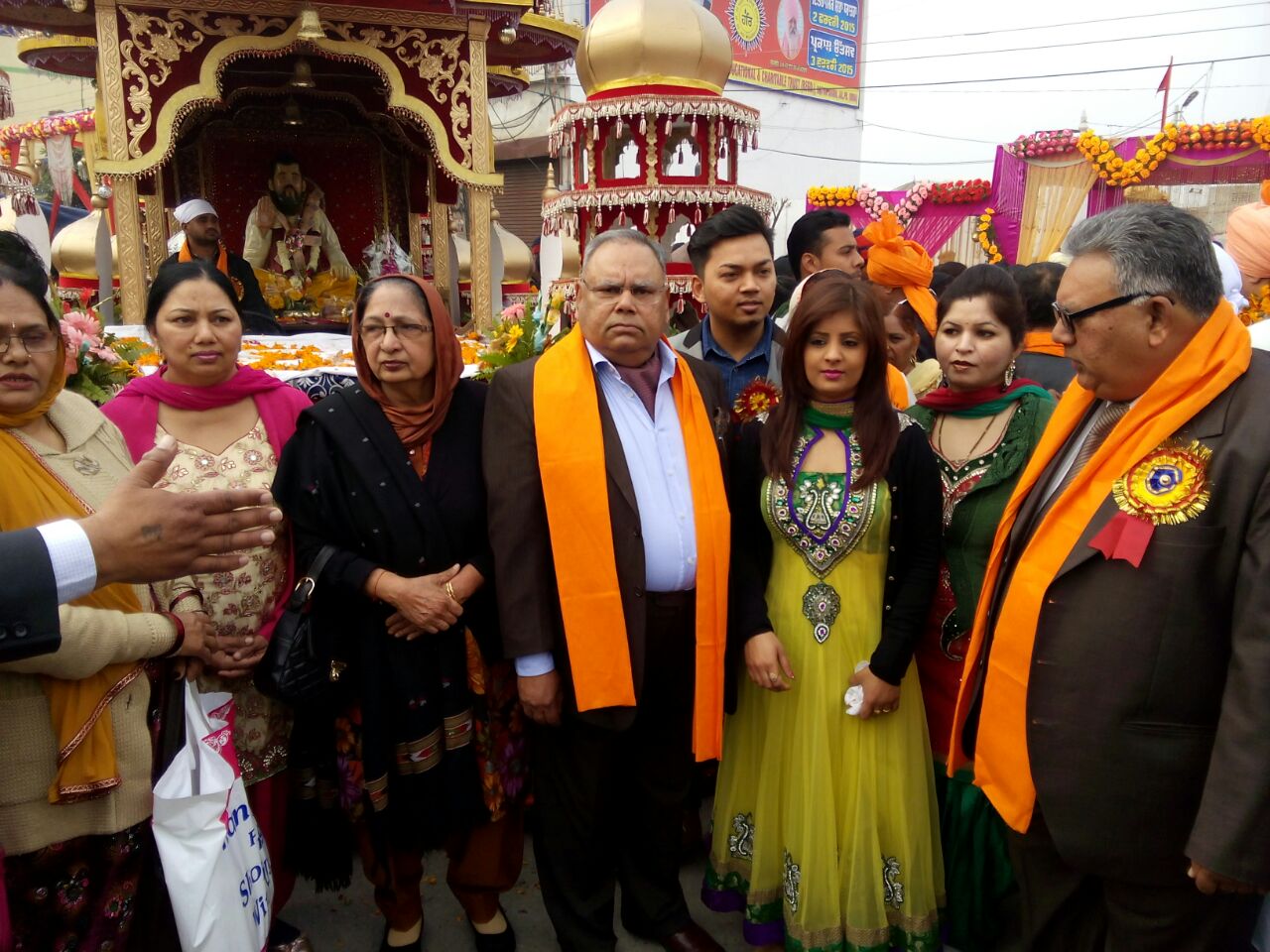
Today, February 22, is Guru Ravidassji’s Gurpurab. It is celebrated all over India and abroad wherever the followers of the great guru reside. As usual, this year also the Gurpurab is being celebrated and observed with pomp and show and desired solemnity at Bootan Mandi, a locality in Jalandhar where my roots are. Bootan Mandi is decked like a bride. Each and every house and building in and around Bootan Mandi is illuminated like Diwali. The glory of Satguru Ravidass Dham, as expected, gets all the more enhanced with the resultant gaiety. The entire Bootan Mandi becomes a splendid venue of a huge mela for three days. There was a mammoth Shobha Yartra (procession) in this regard on February 20, a regular feature of the celebrations. A sea of humanity, spontaneously, comes out with flags, bands, dhols, tableaus, dance and music, langars; make shift stages to welcome the Yatra which creates a spectacle of huge a mela covering the entire city of Jalandhar. Sometimes it tends to become a scene of traffic chaos but by and large people know this before hand and happily accept it as it comes as it has become an important date in the life of the city for almost 80 years. I was told that Shobha Yatra (earlier known as Jaloos) was taken out for the first time in 1937 under the leadership of Seth Kishan Dass and Seth Sunder Dass. It starts from Bootan Mandi with the huge drum (Tamak) on the lead
Drum (Tamak) at Shobha Yatra
as the fore-bearer of the Jaloos, covering the main thoroughfares of the city, after replenishing and raising the Nishan Sahib (flag) at the headquarters of Ad-Dharam Mandal at Mohalla Kishanpura. It terminates in the evening at Bootan Mandi from where it originated. Over the years, the event has gained much in size and content which is a clear demonstration of the increasing empowerment of the followers of Guru Ravidass.  I wrote about Bootan Mandi and the Gurpurab of Guru Ravidass in this blog many a times before. Today, I will write about this from a different perspective.

On the Gurpurab day, there was a tradition of hosting a Kavi Darbar (poetry recital) session in the evening. It used to be a good tradition. I vividly remember the kavi darbars in the late 1960s in which famous and renowned poets like Vidhata Singh Teer, Hazara Singh Mustak, Kartar Singh Balagan, Charan Singh Safri, Gurdass Ram Alam, Pritam Ramdasspuri, Chanan Lal Manik, Bhagmal Pagal among many others regaled the audiences year after year with their poetic renditions along with their singer counterparts like, inter alia, Piara Singh Panchi, Lal Chand Kamla, Narinder Biba, Mohan Bangar. In those years, these celebrations were conducted with spiritual dedication and sobriety. It was my honour to be one of the organizers of these functions as General Secretary of the then Guru Ravidass Welfare Society. Later, if I say so, with the further economic prosperity of the Seths, who came to the helm to manage such functions of Bootan Mandi, money got a higher
Shobha Yatra at Bootan Mandi
manifestation and they started to invite some of the highest paid professional singers who entertained the audiences with their well equipped orchestras. It will not be an exaggeration to say that if their names are listed it will become a Who’s Who of the top notch Punjabi singers. Hans Raj Hans remained on the lead for many years in this regard as he identified himself with the Bootan Mandi crowd as one of them and rightly so. His famous rendition “Do Patar Anaran De; je Sanu Milan Hove Behde Aajan Chamara De” sung in modified Punjabi folk style “Mahaiya” at Bootan Mandi became an instant hit. His famous number at Bootan Mandi was “
Sohna Punjab da shehar Jalandhar Bootan Mandi Jisde Andar”. As the missionary songs like “Sare Kar Lao Eka Begumpura Vasauna Aa” sung by the vivacious and beautiful singer Miss Pooja and a young athletic K.S. Makhan’s “Sanu Babasaheb Ne Dite Laike Haq Barabar De”. My own kith and kin, my Chachaji Jai Ram Parwana and brother Paramjit also contributed positively to the process. Their songs were sung by famous singers like Hans Raj Hans and others at the celebrations of Gurpurab at Bootan Mandi many a times. Jai Ram Parwana’s song “Sare Nar Nari Karde Shingar Ji; Aj Bootan Mandi Lage Mutyar Ji” got much acclaim. Paramjit also remained the General Secretary of Guru Ravidass Educational and Charitable Trust for many years in the 1990s.

As I said, the growing clout and prosperity in and around Bootan Mandi and also its resultant awakening and empowerment, the character of these celebrations also saw a drastic change in content and style. The writers and singers vied among themselves to come out with new songs and albums every year invoking the name of Bootan Mandi in their songs and performances. I heard live last year at Bootan Mandi,  Sufi singers Nooran Sister, who also have their roots (grand daughters of famous Bibi Nooran of Bootan Mandi) in Bootan Mandi, their rendition “Bootan Mandi Aake Lag Janda Dil Bhagto”.  The legendry Kanth Kaler praising the spectacular illumination and fun and frolic at Bootan Mandi sang “Bootan Mandi Aajo Jihne Wekhna Nazara Eh.” K.S. Makhan performed at Bootan Mandi with élan “ Vich Bootan Mandi De Aj Laggiyan Ronkan Bhari “ and “Sajawat Karke Kar Gaye Jhandi lishka Mare Bootan Mandi.” Another son of the soil, Master Saleem, who will also perform today at Bootan Mandi, sang some years before “Aawo Sangte Aj Nachiye Te Gaayiye Aapan; Bootan Mandi Janam Dihada Khushiyan Naal Manayiye Aapan.”  He might come up with some other number invoking Bootan Mandi to please the devoted audience. Yet another young Bootan Mandian Sonu Sunil wrote and sang “Bootan Mandi Dhol Wajda; Dhol Wajda Te Naal Nagade.” Babbu Jalandharia has come out with his latest number “Bootan Mandi Mela Lageya; Painde Bhangre Te Lagde Jai Kaare Bootan Mandi Mela Lageya.” The majestic Satguru Ravidass Dham along with the entire area of Bootan Mandi and around has been fully illuminated today that is why it has been sung by Shashi Shahid “Jagmag-Jagmag Kardi Sadi Bootan Mandi.” There may be many more such compositions and songs on the celebrations of the Gurpurab of Guru Ravidassji at Bootan Mandi which have missed my attention.

 It is a matter of satisfaction and pride for Bootan Mandians like me on one hand and food for introspection and thought, on the other, as to how should the elated position of Bootan Mandi be protected and maintained. It worries me sometimes as what I see and witness, of late, is not very much encouraging. The people at the helm, it seems, have no vision. They are engaged in their narrow agendas and directionless pursuits. The community is on the upswing in general but the coveted status of Bootan Mandi, it seems, is on the path of erosion. It is a matter of concern. Bootan Mandi produced stalwarts like Seth Kishan Dass, who was an MLA before partition, Seth Khushi Ram who was the Vice President of Jalandhar Municipal Committee in the 1970s, Piara Ram Dhanowalia (though he belonged to Dhanowal village near Jalandhar yet he belonged to Bootan Mandi for his political career and business), Minister in the Punjab governments in the late 1960, Surinder Mahey, a self made man, rose to the coveted position of the Mayor of Jalandhar in mid 2010. Avinash Chander, a seasoned politician, is the Chief Parliamentary Secretary in the Government of Punjab for a long time. In the services and other careers, my fellow Bootan Mandians have done fairly well. Sushil Sheemar, ITS is the Director in the Ministry of Communications and IT, His wife, Jaswinder (Lovely) Sheemar is an Additional Sessions Judge, Babita Kler, PCS, wife of Steven Kler, leading businessman and his sister Anupam Kler, PCS are senior bureaucrats in Punjab. Yet another daughter of Bootan Mandi, Sunita, physically challenged vivacious young lady, is a senior Judge. Two young Bootan Mandian brothers, Sunil Kler and Pawan Kler have recently made it to the PCS. There are doctors and Engineers and other professionals like Jagdish Mahey, a senior Banker who belong to Bootan Mandi. I myself, a humble Bootan Mandian, ended up as an Ambassador in the IFS. Many families of Bootan Mandi did well in their leather business including that of Seth Satpal Mall who is the current President of Guru Ravidass Educational and Charitable Trust for many years. With the changing ground realities it is advisable, in my personal view, to hand over the reins to the upcoming and younger generation. Let us try our best to retain, maintain and enhance the glory of our Bootan Mandi, an unofficial capital of dalit community in the years to come as visualized and eulogized by the writers and singers. I think it will be a befitting tribute to the greatest Guru Ravidassji while celebrating his Gurpurab at Bootan Mandi.

With this, I conclude and pay my hearty greetings to all the followers of Guru Ravidassji on his Gurpurab. On the glory of majestic Satguru Ravidass Dham, I quote Allma Iqbal:

दुनिया के तीर्थों से ऊंचा हो अपना  तीर्थ ;
दामाने आसमां से इस का कलश मिला दें !
सुबह उठके गाएं मंतर वह मीठे मीठे;
सारे पुजारिओं को मय पीत की पिला दें !