Tuesday, March 14, 2017

Talk on India’s Foreign Policy

Talk on India’s Foreign Policy

I was invited to talk to students of the esteemed Banarsi Dass Arya Girls College in Jalandhar on March 7, 2017 about India’s Foreign Policy. Accordingly, I spoke at a well organized function and gave an overview of the foreign policy of India starting from its historical perspective and concluding with the current contours of the policy. My talk was primarily based on the book ‘India’s Foreign Policy’ written by a renowned diplomat and former Foreign Secretary and National Security Adviser, J.N. Dixit. In the concluding phase, I relied on the speeches of Foreign Secretary Dr. S. Jaishankar and PM Narendra Modi delivered at the recently
concluded ‘Raisina Dialogue’ in January, 2017 in New Delhi. The intension was not to provide in-depth analysis with academic or intellectual expression but to make it as simple as possible for the benefit of the young students mostly with rural background and schooling. I think, going by the apt attention in the full-to-capacity auditorium and subsequent interaction and also by the remarks made by the other speakers, the talk was well received. It was a matter of satisfaction for me.

 Informing the young students about the functions of an Indian diplomat, I briefly mentioned about the Indian Foreign Service and mode of entry into the service for the benefit of the would-be aspirants to join the service. It was much appreciated. After providing the historical background and evolution of India’s foreign policy since independence in 1947, I mentioned that the strategic intent is shaped by our civilizational ethos and quoted PM Narendra Modi for the cardinal principles of the policy:

 
यथार्थवाद(realism),सह-अस्तित्व(co-existence)सहयोग (cooperation),तथा सहभागिता (partnership).

Concluding the talk, I said that experts were of the view that “in the world of diplomacy, some things are better left unsaid”. I would like to go by that advice and quoted Ambassador T.P. Srinivasan “Diplomacy is about words – written, spoken and unspoken”

Professor Jagdish Chander Joshi, an advisor to the college, was instrumental in introducing me to the college and inviting me to speak at the event. He spoke with conviction and while introducing me to the audience said Jalandhar was proud of producing diplomats of high caliber and intellect and named Prof. Manohar Lal Sondhi, Ambassador Bal Anand, Ambassador Sharat Sabharwal among others. Being a professor of history, he touched
upon the concept of buffer states and their desirability and importance in the shaping of foreign policy of India particularly with reference to Afghanistan and Tibet. Lt. Col. Manmohan Singh, Former District Sainik Welfare Officer and Former Director of National Institute of Competitive Examinations also spoke and advised the students to learn and get ready to enter their respective careers including the IFS. Principal Sarita Verma in her welcome address said that it was an honour for the college to invite and listen to the talk on India’s foreign policy and said that the students would certainly benefit from it and get motivated to join the IFS in the days to come. She also thanked Prof. Neeru Sharma Head of the Political Science Department of the College for organizing the function at a short notice. Commander of the BSF (Retired) P.K. Mohla who himself served with the Indian Peace Keeping Force in Eastern Europe in the late 1990s was also present on the dais. Prof. Meenu Nanda conducted the function as an expert Master of Ceremonies and regaled the audience with her poetic interjections.

As stated in the college website - Banarsi Dass Arya Girls College is one of the leading educational institutions of Jalandhar catering to the educational needs of both urban and rural areas. The college was founded by Arya Samaj  in 1964. B.D. Arya Girls Collge as a full-fledged affiliated college came into existence in 1970. The college has emerged as an operational model for value oriented education in and around Jalandhar Cantonment area.. Besides academic excellence, the college encourages maximum participation of students in sports and extra co-curricular activities.


Sunday, February 26, 2017

Prof. M.L. Sondhi Memorial Lecture – II: India China Relations

Prof. M.L. Sondhi Memorial Lecture – II: India China Relations

The Second Prof. M. L. Sondhi Lecture was held on February 20, 2017. It was hosted by the designated and appointed agency - an esteemed educational institution – DAV College in Jalandhar, Punjab under the aegis of Prof. M.L. Sondhi Trust headed by Ms.
Madhuri Sondhi, the illustrious and gracious wife of Late Prof. Manohar Lal Sondhi an alumnus of DAV College Jalandhar. The lecture was delivered by an eminent diplomat and a China watcher, Ambassador Ashok Kantha, on the theme “The Current Dimensions of the Global Role of China and India-China Relations” The lecture was well attended by students and faculty of the college and also by the cross sections of the academia in and around Jalandhar.

Before joining the audience at the college auditorium for the lecture, Chief Guest Ambassador Ashok Kantha and other important guests were received and conducted by Principal Dr. S.K Arora to the college’s Hall of Fame located at the sanctum sanctorum of the 100 acres of sprawling premises of the institution.
It was a journey down memory lane adorned by the photographs of distinguished visitors and an eminent galaxy of the college alumni from different walks of life. Being one of the humble alumni of the esteemed college, I felt elated and was filled with a sense of satisfaction with step in step with my Alma mater.

At the auditorium, the venue of the lecture, Ambassador Ashok Kantha, Ms. Madhuri Sondhi and other guests were received by the representatives of students with garlands and bouquets with the traditional rituals of Tilak and chanting of Vedic mantras led by Seth Kundan Lal, Chairman of the Local Advisory Committee of
the college. The guests were conducted to the High table which was lined up by the Keynote speaker Ambassador Ashok Kantha, flanked by Ms. Madhuri Sondhi and Jalandhar Police Commissioner Arpit Shukla who presided over the function along with Seth Kundan Lal, Principal Dr. S.K. Arora, Dr. Rajeev Kunwar and Prof. Sharad Manocha and  I, myself. I was touched by the grace and magnanimity showered on me by my alma mater. The function started with the DAV anthem and lighting of traditional lamp.

Principal S.K. Arora welcomed the Chief Guest and other guests and said it was a matter of pride for them to host Prof. M.L. Sondhi Memorial lecture instituted in the name of one of their own alumni. Chairperson of Prof. M.L. Sondhi Memorial Trust Ms. Madhuri Sondhi apprised the audience about the Trust and thanked the management of the DAV College for hosting the second lecture in the memory of her late husband. She thanked, especially, Ambassador Bal Anand for his unstinted support in identifying the right and befitting key note speaker, Ambassador Ashok Kantha, for the occasion. Principal Jagdish Chander Joshi, a renowned scholar of history and a prolific exponent of Urdu poetry, spoke with conviction and authority about the life and values of Prof. M.L. Sondhi. Quoting Faiz Ahmed Faiz, Prof. Joshi paid glowing tributes to Prof. Sondhi and said:

Meri Zindagi Ka Maqsad, Ke Har Ik Ko Faiz Pahunche;
Main Chraagh-e-Raah-e-Manzil, Mujhe Har Koi Jalaai.

(Rendered into English, the couplet will be worded thus – The purpose of my life is that everyone should benefit through one’s deeds; I am a sort of lamp indicating the path leading to destiny and thus everyone should light this lamp for others)
Prof. Sharad Manocha introducing the Keynote Speaker said that Ambassador Ashok Kantha was an eminent personality and authority on India-China Relations and added that the lecture will be a land mark in the calendar of activities of DAV College.

Ambassador Ashok Kantha, as it was expected, gave a dispassionate and objective overview of the subject of the lecture “The Current Dimensions of Global Role of China and India-China Relation” to the fully engaged audience. Ambassador Kantha said China was already a global power with a big stake in the world order. He termed India-China Relations as ‘difficult’ which often comes ‘under stress’ due to historical and strategic reasons. He added that given the status of both India and China, we needed to look ‘beyond bi-lateral aspects of the relations’. He mentioned about the desirability of ‘multi-polar world and multi-polar Asia’. Referring to the increased interest of China in Pakistan and our other neibhouring countries, Ambassador Kantha said that it will remain so and termed it as ‘investment for the future’. Concluding his lecture, Ambassador Kantha said that it was gratifying to note that in spite of difficulties the India-China Relations are saddled with positives.  He pleaded for ‘strategic maturity’, pragmatic approach and fresh agenda to provide impetus to the relations for a ‘simultaneous rise’ of both the great countries. The lecture was followed by an interactive session which was lively with interesting and relevant questions from the students. It appeared they must have prepared themselves for the day under watchful guidance by their teachers and trainers.

Police Commissioner of Jalandhar Arpit Shukla in his brief Presidential remarks appreciated Ambassador Ashok Kantha for his topical address and thanked the college for inviting him. Though I was not a listed speaker yet to my happy surprise I was also invited to the podium to say a few words. It was an honour for me. I
recalled my association and interaction with my senior colleague Ambassador Kantha and thanked him for a thought provoking lecture as one of the finest diplomats of India. Braking from the seriousness of the subject, I thought of narrating a few anecdotes, to lighten the atmosphere, from our personal experiences of exciting incidents during our stay in Beijing (then Peking). It brought down the house to a relaxing state. The function was concluded and rightly so by a Vote of Thanks by Prof. Rajeev Kunwar, Dean of DAV College Alumni Association followed by the National Anthem.

We will look forward to many more such good activities in this centenary year of DAV College Jalandar in the run up to the 3rd Prof. M.L. Sondhi Lecture in February, 2018.


Friday, February 24, 2017

Punjabi Likhari Sabha

Punjabi Likhari Sabha

 I don’t have, to be frank, much interest in literature as I find myself nowhere near the creative people like writers and poets both in temperament and intellect. I think writing is a God gifted talent. But I do have some interest in the Punjabi culture, Punjabi poetry and also Urdu poetry written in Devnagri script.  February 15, 2017, I was honoured to be with a galaxy of Punjabi prose, story and poetry writers under the aegis of Jalandhar Punjabi Likhari Sabha at their monthly meeting. It was a pleasurable and a rewarding evening. I must thank my friend Param Dass Heer who himself is a Punjabi poet and a geetkar of standing who took the initiative and invited and introduced me to the Sabha of which Param Heer is the General Secretary. I was touched by their respect
and regard showered on me at the function under the leadership of a renowned social and spiritual community activist Sardar Beant Singh Sarhadi. Punjabi Likhari Sabha is a club of intellectuals and literary people which is engaged in catering to the literary and cultural needs of the concerned and interested, in and around Jalandhar, for the last 45 years with self support. One can understand the contribution the Sabha has been making in promotion of the creative activities for the benefit of the community at large.

This month’s meeting of the Sabha was dedicated to the memory of Guru Ravidassji whose Gurpurab was observed some days before. Many poets of standing and also of up-coming genre recited their poetic compositions and paid glowing tributes to the great Guru. A book of poems for children “Nikke Nikke Phul Kalian” written by Sardar Sujaan Singh Sujaan was released together with the author
and Sardar Beant Singh Sarhadi, Param Heer and Deepak Bali, General Secretary of Punjab Jagrati Manch. I was told that Sujaan Sahib is a poet of his own standing and recites poetry in Tarannum. Deepak Bali spoke briefly and informed about their efforts to promote our mother tongue Punjabi. My hosts gifted me a set of books – Muhabat Nama of Ashi Ishpuri, Phoolan Dian Khushbuaan of Param Heer, Punj Abban Di Jaie of Bibi Surjit Kaur and Samen Da Sach of Surjit Singh. I am sure that by reading, which I will do in due course, these poetry books would help in enriching my feeble knowledge of Punjabi literature.

I will cherish the memory of this honour in the years to come. While thanking the Punjabi Likhari Sabha I said in my brief remarks that a written word had an immense force to register its impact as an English poet John Keating said, “No matter what anybody tells you; words and ideas can change the world.”  I added that famous Punjabi writer Surjit Patter had also said in one of his poems:

ਇਹ ਪਹਿਲਾਂ ਆਪਣੇ; ਫਿਰ ਦੂਜਿਆਂ ਦੇ,
ਗ਼ਜ਼ਲ ਤਾਂ ਦਿਲ ਵਿਚ ਉਤਰਨ ਦਾ ਨਾਂ ਹੈ !
I also recalled the poetry of a rustic Punjabi poet Gurdass Ram Alam who attributed the qualities of a good poet:

ਸ਼ਾਇਰ ਓਹੀ ਜਹਾਨ ਵਿਚ ਹੋ ਸਕਦਾ;
ਜੋ ਸੋਨੇ ਨੂੰ ਸੋਨਾ ਤੇ ਕੱਚ ਨੂੰ ਕੱਚ ਆਖੇ !
ਕਰੇ ਲੋਕਾਂ ਦੇ ਦਿਲਾਂ ਦੀ ਤਰਜ਼ੁਮਾਨੀ;
ਝੂਠ ਨੂੰ  ਝੂਠ ਤੇ ਸੱਚ ਨੂੰ ਸੱਚ ਆਖੇ !
Finally to register my sense of gratitude to the Punjabi Likhari  Sabha and tributes to Guru Ravidassji, I said that it was good to be here today in the company of learned and enlightened people and added that a novice and humble  man like me would tend to gain from this good Sangat as Guru Ravidassji said in his Bani:

ਤੁਮ ਚੰਦਨ ਹਮ ਰਿੰਡ ਬਾਪੁਰੋ ਸੰਘ ਤੁਮਾਰੇ ਵਾਸਾ;
ਨੀਚ ਰੁੱਖ ਤੇ ਉਂਚ ਭਏ ਹੋ ਗੰਧ ਸੁਗੰਧ ਨਿਵਾਸਾ !


Saturday, February 11, 2017

Mark Juergensmeyer

Mark Juergensmeyer – Orfalea Centre for Global and International Studies

Mark Juergensmeyer, Professor of Sociology and Global Studies and Director of Orfalea Centre at University of California, is a renowned scholar and researcher of social and religious issues concerning a cross section of societies throughout the world. I had heard of him and also read about his pioneering works about the social and religious movements of dalits in Punjab. But I was not aware of the fact that Mark had a much larger and pronounced persona till I met him in Jalandhar on January 18, 2017 at the sprawling villa of my friend Manohar Lal Mahey. Thank you Manohar for introducing me and providing me chance to meet and
interact with Mark in an informal session on a chilly evening but thoughtfully taken care of with hot and spicy tomato soup and snacks. It was a pleasure to meet Mark along with others, inter alia, Lahori Ram Balley, Dr. Gian Kaul, Dr. Santokh Virdi, Baldev Bhardwaj and Prof. Singh who was accompanying Mark from Delhi to facilitate his Punjab visit. Like a good scholar, Mark Juergensmeyer speaks less and listens more. I was impressed by his personality and demeanor.

 I had heard about Mark’s visit to my native place Bootan Mandi and other spots in and around Jalandhar in the early 1970s in pursuit of his pioneering research work – Religious Rebels of the Punjab: The Ad-dharam Challenge to Caste and its later edition The Social Vision of Untouchability. These books are not readily available now. I would like to read them at leisure as and when I happen to source them. My friend Manohar Mahey, Santokh Virdi and Lahori Ram Balley found mention in these books as the worthy author met and interacted with them in the making of these books. Obviously, they were happy and appreciative of Mark. But one of my other friends in Bootan Mandi who is also socially active and well read otherwise commented that the book of Mark under mention was ‘full of half truths’ as the source persons were not fully objective in their approach. Nevertheless, I must register recognition of a wonderful contribution of Mark in generating much needed awareness of the contemporary history of dalits in Punjab.

As stated by Mark, the purpose of his current visit was to work on his latest project pertaining to the Khalistan, yet another important subject to Punjab and Punjabis at large. During the interaction, it transpired that Khalistan was a dead horse. I questioned the very genesis of Khalistan. The idea is kept, to my mind, alive by some vested interests in the well maintained and stocked drawing rooms in Europe, USA and other developed countries. Mark enquired about the future of Ad-dharam in Punjab and elsewhere? It was a relevant question in the fast changing political and social scenario. My off the cuff response was that there was no future of Ad-dharam and the newly floated Ravidassia Dharam by the Dera Sachkhand Balan. The Ad-dharam has lost its relevance and wherewithal. The Ravidassia Dharam is a half baked and ill conceived idea and is bound to fade away in the years to come. Perhaps,  researchers and historians like Mark will have food for thought and action in the process.
Anyway, it was nice to sit and talk with Mark Juergensmeyer. With a view to introduce Mark and his Indian connection , let me quote from a write up which I read recently, “ He lived in India from 1966 to 1967 where he taught political science at the Panjab University in Chandigarh and worked in famine relief in the Indian state of Bihar. He joined the Gandhian Sarvodaya Movement, working directly with its leader, Jayaprakash Narayan”
After meeting Mark Juergensmeyer, we became Facebook friends. I can follow him and interact with him. He is a committed scholar to work with difficult projects in challenging circumstances. His ongoing work on movements like ISIS, Kurdish etc. would be worth watching. I wish Mark all the best in the years to come.


Wednesday, February 8, 2017

Political Slugfest Ends – Wait till March 11, 2017

An Open Letter of an AAM AADMI – Political Slug-fest Ends – Wait till March 11, 2017

February 6, 2017

Dear Voters of Punjab,
This is the last but one open letter with regard to the Punjab elections. I will write again after the election results of March 11, 2017. Till then let us keep our fingers crossed.

After the voting on February 4, the fate of all the candidates has been sealed in the EVMs which are stored in the strong rooms of the administration. The voting percentage of about 77.3% of 1.99 crore voters remained lower than expected. It was good that female
voters came out in good numbers as compared to the male voters. The rural areas were found to be more enthusiastic to participate in the festival of democracy as compared to their urban compatriots. It was gratifying to note that it was more or less a peaceful exercise in the face of doubts. Besides these salient points, I think the biggest visible difference this time was that it was a keen three cornered slug-fest since the first elections in 1952. Till about 1967-68, it was a one sided affair with the Congress party in the lead with marginalized opposition from the Left parties, Akali Dal, Jan Sangh among others. The Akali led coalition under Justice Gurnam Singh broke the pattern and unseated the Congress in 1967-68 for the first time. Thereafter, the Congress party and the Akali Dal or Akali Dal led alliances played musical chairs and took turns in governing the state. This time a new player, AAP, appeared on the scene and upset the apple-cart. People in general welcomed this new development as they were yearning for a change. The traditional parties like Congress and Akalis and also the BJP were made to face a real challenge by the volatile volunteers and observers of the AAP. Almost all the 117 constituencies witnessed three cornered contests. Earlier last year, it was felt that AAP was making steady inroads and winning the favour of the general populace but later as time passed it lost the momentum due to infighting and corruption charges etc. Finally, in the run up to the elections on February 4, it turned out to be a keenly contested fight to reach the corridors of power in Chandigarh. The pollsters felt that no one party would be able to make it and it will end up in a stalemate. But after the elections, the revised assessments and analysis indicated that perhaps AAP will be able to make it with 60-65 seats and scrape through to form the next government. Let us wait for March 11 results and see the wonders of democracy.

Being a novice observer as an Aam Aadmi, I have been advising and sounding the AAP leadership about the importance of dalit vote particularly in the Doaba region. I have been suggesting reaching out to the educated dalit youth and established middle class. Though the dalits are a divided lot on the basis of political affiliations and also under the blind influence of religious and spiritual Deras yet the educated dalits are awakened and are keen to stand to vouch for their core interests. Any party with good and sincere approach to address their interests and concerns was likely to gain their favour.  Out of 23 seats in Doaba where dalits are concentrated, 15 seats depend on the dalit swing. These 10-15 seats would make or mar the next governing dispensation. This is my naïve assessment.

Considering my interest and inclination, on advice from the AAP headquarters in Delhi, I joined AAP on February 24, 2016. It is almost a year now that I have been associated with and working for the party as a humble foot soldier. For me, it has been a mixed but
educative experience. I was an aspirant to contest elections. But my party did not endorse my interest and application for this. I accepted the decision with grace as a trained, faceless and disciplined diplomat. Instead, I decided and worked as a self appointed ‘ears and eyes’ of the party in Jalandhar and shared, mostly in writing, my observations, assessments and analysis with the leadership particularly on the issues of concern and interest to the weaker sections of the society. I only hope that my humble contribution will find due recognition with the AAP leadership in the spirit of poetic expression of an English poet John Milton ‘those who stand and wait also serve’.

With this, I conclude this with all the best wishes to the people of Punjab. They will get the government they deserve after March 11.

With regards,

Yours truly,

(Ramesh Chander)
Ambassador – IFS (Retired)
Tele:09988510940


Tailpiece: Media speaks:


Thursday, February 2, 2017

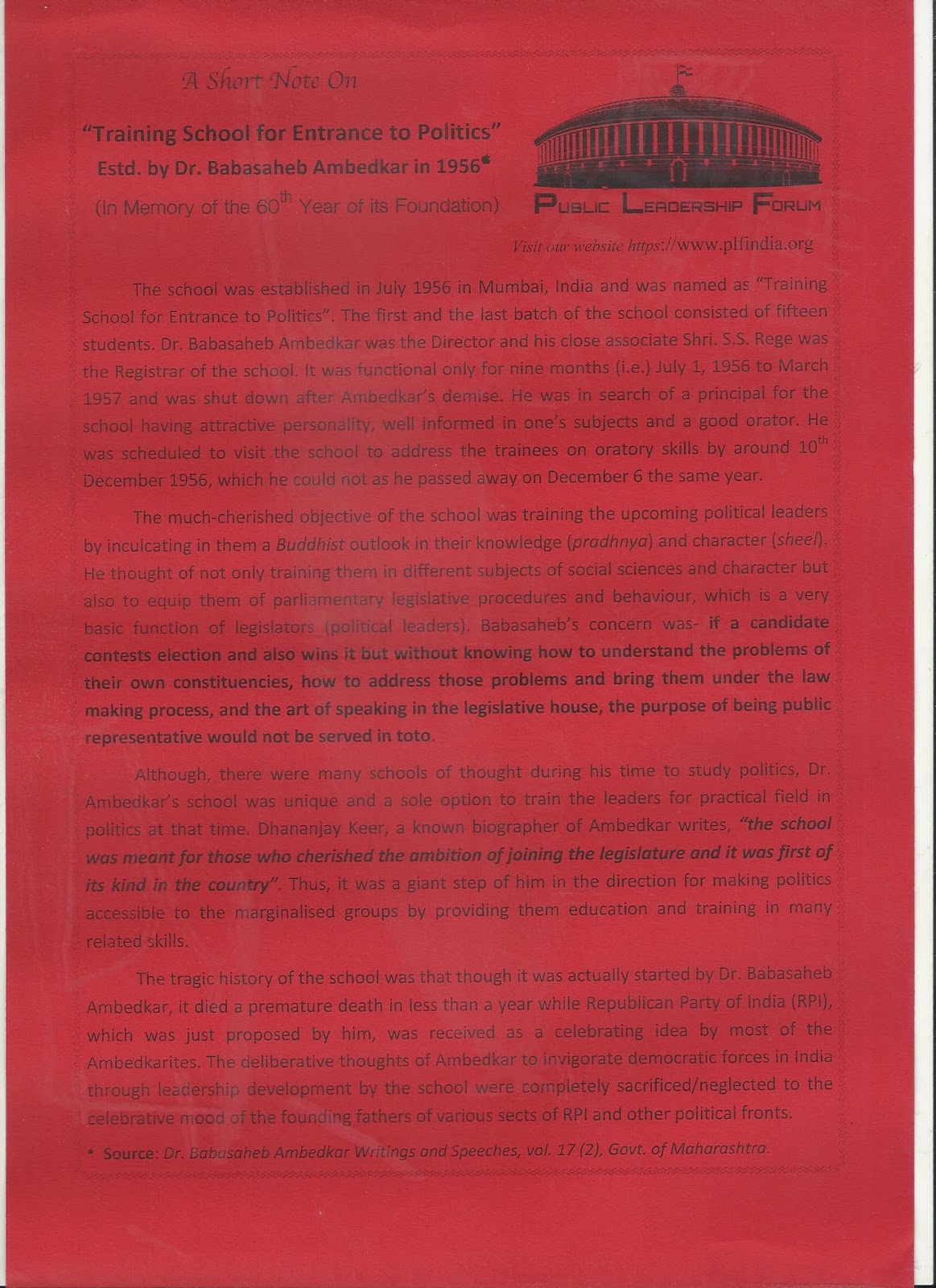
Training School for Entrance to Politics – A flagship project of Dr. B.R. Ambedkar

Training School for Entrance to Politics – A flagship project of Dr. B.R. Ambedkar

India boasts of, and rightly so as the biggest democracy of the world. But at the same time, let me hastily add, that it is yet to become an ideal democracy. Our fore-fathers particularly father of the Indian constitution Dr. B.R. Ambedkar was fully conscious and alive to the fact that we need good political managers and
executives to run the show and play the game of politics.  If we, in the words of Dr. Ambedkar himself, are to transform the political democracy into social and economic democracy, we would need to learn some ‘Dos and Don’ts’ in the game of politics. Dr. Ambedkar thought of these basic requirements and planned to take a two prong approach – one to launch a real democratic and secular political party with a pan-India base and acceptance and second to establish a training school to educate and train competent and good players to enter public life and politics in 1956. He contacted and consulted like-minded public figures, academics, intellectuals and politicians on these two important requirements of the Indian democracy in its infancy. The political party, Dr. Ambedkar thought of, was the one which later, after his death, appeared as the Republican Party of India. The training school, he envisaged, was established in Bombay (Mumbai) in July, 1956 which also could not survive for long. The untimely demise of the great leader and visionary in December, 1956 itself, when these two important projects were just in the making, changed the whole scenario. The demise of Dr. Ambedkar was one of the greatest setbacks to the people who wanted to join hands with him in transforming the murky political scene and to strengthen the foundations of the newly established democracy under the new constitutional arrangements of which he himself was the initiator and proponent.
I will not waste time by writing much about the Republican Party. It was nowhere near in fulfilling the vacuum and meeting the aspirations of the greatest son of India and faded away in due course. Allow me to write about the Training School for Entrance to Politics established by Dr. Ambedkar in July, 1956 of which he himself was the Director. One may assess the importance of the school from this very fact that he himself, in co-operation with his close associate S.S. Rege, who was made registrar of the school, took the responsibility of running this dear project in spite of his failing health. The biographer of Dr. B.R. Ambedkar, Dhananjay Keer said about the School, “the school was meant for those who cherished the ambition of joining the legislature and it was the first of its kind in the country. Dr. Ambedkar himself prepared the syllabus of the school and launched the project with a batch of 15 students. It is said that Babasaheb was scheduled to address the first batch of the students in Bombay on December 10, 1956 but the cruel hand of his untimely death on December 6 intervened to stop it. The followers of Dr. Ambedkar got carried away by their narrow political agenda and did not pay any attention to this important project. The school as such could not be sustained beyond March, 1957.

Sixty long years have gone by. A new hope and a silver lining have appeared on the horizon. Two JNU alumni have decided to undertake and revive the Training School for Entrance to Politics so thoughtfully established by Dr. Ambedkar. Dr. Kshilpa Uke and Dr. Shiv Shankar Das after their intense research and study have taken
up the initiative. It is a welcome step. This scholar couple visited Punjab in mid January, 2017 for the purpose and shared their idea and agenda with the Ambedkarite intelligentsia. It was my pleasure to receive them and host a luncheon meeting for them on January 16 in which about 20 participants from cross sections of the educated segment of the community participated. Our scholar visitors gave us to understand that they were satisfied and happy with the interest and response they received. I take this opportunity to wish them a great success in their highly motivated and enlightened approach to revive the school, a flagship project of the great leader.

The community and the society at large is facing crisis of genuine leadership. Dr. Ambedkar was a visionary leader and thought of the needs of a good and functioning democracy long back in 1956 itself. His approach to politics and public life was based on the Buddhist philosophy of Gyan (knowledge) and Sheel (morality). He was interested and committed to motivate the youth to come forward and get trained to meet the challenges of the future and established a school for the purpose. But it was not to be. With a view to realize the dreams and aspirations of our leader, let us extend all possible cooperation and help to Dr. Kshipra Uke and Dr. Shiv Shankar Das in this regard. As a first step towards this, they have planned a “60th Anniversary Souvenir” for the Training School for Entrance to Politics” and they are in the process of identifying and compiling material and financial resources by way of advertisements etc.. We should help them in this lofty project as a befitting tribute to Babasaheb Ambedkar. The coordinates of Dr. Kshilpa Uke and Dr. Shiv Shankar Das are given below:

Dr. Shiv Shankar Das: Mobile- 09868099669
Dr.Kshipra Uke: Mobile-09868664446


Monday, January 30, 2017

Good Wishes to the AAP

An Open Letter of an AAM AADMI – Good Wishes to the AAP

January 30, 2017

Dear Voters of Punjab,

For the last more than two months, I have been writing every Monday An Open Letter of an AAM AADMI expressing my thinking, making comments and observations and also assessments on the forthcoming Punjab elections with particular reference to the Aam Aadmi Party of which I am a humble volunteer. This will be my last letter before the elections to be held on February 4. I will
conclude this series of letters on Monday, 5th February with some more inputs and calmly wait for the results of this dance of democracy on March, 11 in the run up to formation of the new government in terms of the popular verdict given by the people of Punjab.

Both the AAP and the players have done their best. I take this opportunity to wish the AAP and its candidates all the best and success in realizing their aspirations and goals.

As I have been reiterating that dalit vote in Punjab is crucial. It has the potential of making or marring the next dispensation though it is a divided lot in itself. All parties are not oblivious of this ground reality and focused their campaign in the Doaba region. PM Narendra Modi addressed a public meeting on January 27 at Jalandhar. BJP leader Vijay Sampla, while speaking at the rally, with a view to woo the dalit vote bank, specially mentioned about the Akali-BJP government’s flagship projects – Guru Ravidass Memorial at Khuralgarh and Swami Ram Tirath Memorial at Amritsar. Congress Vice President Rahul went a step further. He not only addressed a rally at Phillour on January 28 but also visited Sachkhand Balan Dera at the outskirts of Jalandhar - the Dera is said have a considerable influence among the dalit voters in the region. Rahul Gandhi declared to name a University after the dalit icon Dr. Ambedkar. AAP while releasing its final manifesto at Chandigarh on January 27 highlighted their offer of the post of Deputy CM to dalits. BSP supremo Mayawati addressed an impressive rally at Phagwara on January 30. It is assessed that a mere 5% vote-swing, in at least 20 constituencies in the Doaba region where dalits are concentrated, will decide the outcome of the elections in the run-up to forming the government. It seems to me, as an Aam Aadmi, right or wrong, that AAP, unlike the traditional parties be it the Congress, Akali Dal, BJP and even BSP, is not fully alive to this hard reality of the Punjab electoral battle.

With a view to rectify the AAP view and placate the dalit educated class, as an Aam Aadmi, I suggested the following three points in this regard to the party leadership for their consideration. I don’t know the party reaction so far except that my communication was duly acknowledged by the high offices of the party. These points are:

1) Support my proposal to declare April 14 (birthday of Dr. Ambedkar) as International Day of Equality - I made this proposal to EAM and PM in May, 2015 and followed up with others. As a result, UN at New York celebrated Dr. Ambedkar's 125th anniversary on April 13, 2016. The enclosed letter of Punjab Speaker, Charanjit Singh Atwal to PM will inform you of the current position of the proposal. My suggestion to Arvind Kejriwal and Sanjay Singh is, as already suggested to the Punjab Dialogue, to make an announcement and assertion that if AAP comes to power in Punjab, the Punjab cabinet and the assembly will pass a resolution and forward it to the Government of India and PM for making a demarche to UN in support of the proposal to declare April 14 as the International Day of equality. It will catch up with the imagination of the dalit youth and benefit the party a great deal. For any further information and clarification, I am available at anytime.

2) Support to Training School for Entrance to Politics - Dr. Ambedkar started this School in July, 1956 at Bombay just a few months before his untimely demise in December, 1956. The School could not continue. There is a proposal to revive the School. The enclosed brief note on the subject will give more information. Given the AAP's own agenda to clean politics and inculcate moral values to politics, support to the revival of the School started by Dr. Ambedkar will go a long way in attracting the imagination of the followers of the greatest son of India. Dr. Shiv Shankar Das and Dr. Kshipra Uke, two JNU scholars have taken up the project. They visited Jalandhar last week and discussed the matter with Ambedkarite intelligentsia. Dr. Kshipra Uke may be contacted on Phone: 09868099669 for further details if required.  I am also available for any further talk on the subject.

3) Special arrangements and facilities for dalit youth to get trained for officer level entry in to Armed forces and central para-military and police forces. You are aware that there is hardly any recruitment of dalits into these forces because there is no reservation. In the absence of reservation, it will be good if dalit youth get special training and motivation to join these outfits. AAP may like to take the credit of bring in this out of the box idea. It will be much appreciated.


As I believed in the in the lofty ideal that politicians need not lie, I thought of sharing this with the voters of Punjab before they go for casting their vote on February 4. With this, I would like to conclude my letter with one suggestion and advice to my dalit brethren. It is a fact and I have been repeating and reiterating it quite often that dalits in spite of their demographic position are nowhere near their due space and share in the corridors of power as they are a divided lot and as such does not have any voice. They are divided on the basis of party affiliations and compete among themselves. This fact has marginalized their strength and even existence. What is the way out? The way out, to my mind, is that they that is the community should unite and stand with one party. Which could be that party? In the given circumstances, the time and political compulsions has thrown a viable option in the form of AAP. The traditional parties have failed in addressing the dalit issues. Let us give a chance to the new player that is AAP which professes to be a party standing for systemic change, transparency, social and economic vision for the empowerment of the weaker sections of the society. If dalits unite and stand by AAP and bring in seats to the kitty of AAP in a substantial measure, they every right and chance to ask for their due share in the power structures of Punjab. Why they should contend with the offer of Deputy CM’s position alone? They can and rightly so even aspire for the coveted post of the CM. After all numbers count in democracy.

With this, I wish AAP and its candidates all the best on February 4 and March 11. I stand for change a positive change.

With regards,

Yours truly,
(Ramesh Chander)
Ambassador – IFS (Retired)
Tele: 09988510940
Enclosures:
Speaker Charanjit Singh Atwal’s letter and A brief Write up on the Training School for Entrance: