Friday, November 11, 2016

SPEED – Let us wish It a God Speed


I wrote earlier also about SPEED – Society for the Poor’s
Educational and Economic Development, an outfit of educated and well placed retired and serving professionals and administrators and academics interested in the empowerment of the weaker sections of the society. It is matter of gratification that over the years, SPEED has done well and has undertaken many projects to help the needy under the stewardship of my friends Janak Chauhan, a retired Bank Officer, Dr. Ram Lubhaya Jassi, IPS – Retired ADGP and others.

On November 6, SPEED opened its 7th Computer Centre in and around Jalandhar at Floret Public School in Ram Nagar for the benefit of the poor students of the area. The computer centre at Ram Nagar has been rightly dedicated to the memory of Dr. V.K.
Tiwari, a renowned educationist who was one of the supporters and patrons of SPEED. It was nice to meet the gracious wife of Dr. Tiwari, Dr. Savita Tiwari who was the chief guest at the function, an academic and an acclaimed artist herself. Though I have had pleasure to know Dr. V.K. Tiwari a little bit yet Dr. Savita Tiwari’s emotional and spontaneous speech about her beloved husband touched the core of my heart. Dr. V.K. Tiwari was a man of sterling worth. Again it is a matter of satisfaction that these days our banking system has come a full circle. The banks are actively engaged in social and community activities. Shri Baldev Raj Dhiman, Regional Executive of Bank of Baroda was the guest of honour at the function who helped SPEED not only in the Ram Nagar project but in its earlier projects by providing computers and other accessories. It was good to meet and listen to Baldev Dhiman, particularly his advice on financial literacy and management required for the economic well being of the weaker segments of the society. The chain of Floret Public Schools is run by a dynamic personality, Dr. Jagan Nath Paul of Dr. B.R. Ambedkar Educational Organization, a staunch Ambedkarite and a recognized and respected social activist in the area. It was good to meet and interact with him.

Janak Chauhan informed that SPEED is in the process of opening more such schools in the days to come. He also informed that SPEED has also started some professional courses for the poor students which are duly registered and recognized by the various authorities including Ministry of HRD. Assistant Director M.R. Sallan of Central Institute of Hand Tools also spoke and gave an overview of the short and long term courses being run by his organization situated in the outskirts of Jalandhar. Most of the people are not aware of these facilities available in the area. It was a good effort on the part of SPEED and Dr. Salan to generate much needed awareness for the benefit of the interest people.


I also presented a computer to the SPEED’s Computer Centre at Floret Public School at Ram Nagar as my humble contribution in support of SPEED. I take this opportunity to wish SPEED - A GOD SPEED.

Tuesday, November 8, 2016

Operation …Blue Star – The True Story


I ordered the revised edition of the book Operation … Blue Star – The True Story written by no other but Lt. Gen. K.S. Brar who
himself led the “most controversial and hotly debated military operations in the history” sometime last year but could not unwrap and read it. I traveled to Delhi from Jalandhar on Amritsar Shatabadi last month on October 18 and took the book with me to read while travelling. It was a good start. A young lady, an IT expert working in Gurgaon (I am finding it difficult to recall her name now) who was sitting by my side saw the book on my table and spontaneously commented that it was a good book which she had read last week. I was further motivated to read the book. I stayed with my senior diplomatic colleague and a good friend Ambassador Bal Anand at their newly built house at the lush green and peaceful IFS Villas at Greater Noida and enjoyed their hospitality over numerous sessions of informal chats on subjects of mutual interests one among them literature and general love for books. Though I also claim to have some interest in reading and writing of which my hosts were aware yet I am nowhere near Ambassador Bal Anand, a vivid reader and a prolific writer. I informed him that I was reading the book of General Brar on operation Blue Star. He advised that I should write a review of the book on my return to Jalandhar. Here I attempt one not as an expert but as a common reader.

Since the Operation Blue Star at the Harimandir Sahib (Golden Temple) at Amritsar, the seat of spiritual status and power of the Sikhs, 32 long years have gone by. But this unpleasant scar in the contemporary history of India is still alive and will remain so in the years to come. In the aftermath of the infamous operation in June, 1984, the sad and uncalled for happenings on October 31 in which PM Indira Gandhi was assassinated and the consequent holocaust in Delhi and other places against our Sikh brethren are the festering wounds which require constant balm to get some much needed relief. While I am writing a review of the book of General Brar today on November 3, the air in Punjab is thick with the sordid happenings of 1984 which, to my mind, should be removed from the psyche and forgotten like a bad dream. Such first hand and objective accounts given by the actual actors and players would certainly put the things in their right perspective. Lt. Gen. K.S. Brar has done a good job in writing the book “Operation … Blue Star – the True Story.

General Brar is quite candid when he says in the preface of the book itself “I know that many will disagree with some of my observations and comments but then, the true test of the book of this nature is that it should evoke discussion and introspection, which I hope will be healthy and honest not bitter and acrimonious.” The ground situation has belied the expectations of the author. It is unfortunate. The hard core elements are getting strength both in temporal and spiritual Sikh hierarchy - Miri and Piri. There are vested political interests. The successive governments could not demonstrate strong will power to address the causes and concerns which were responsible for the military action at Amritsar in June 1984 and its fallout in October, 1984. A sincere introspection is needed as advised by the author of the book.

I fully agree with General Brar when he says “Operation Blue Star was launched in order to preserve the country’s unity and integrity and it can perhaps, be classified as one of the most traumatic, sensitive and thankless missions ever undertaken by any army of the world.” The Indian army, one of the most dedicated and professional armies of the world as also recognized and appreciated by the UN in its various peace keeping operations, did a job under difficult and trying situations and circumstances. General K. Sundarji, who was also one of the chief players in the operation commented and said “We did not go in anger but with sadness; with prayers on our lips and humility in our hearts.”  The role of General Sundarji in the operation will find a mention in the proceeding paras of this review of the book. The army did its duty. There should be no bitterness or ill feeling against the army. It will serve as the first step to forget and forgive the sad and traumatic experience like a bad dream.

The social, political and security situation in Punjab in the late 1970s and 1980,s, in wake of militancy and political expediency, have been well documented and need no elaboration. All the main political parties i.e. the Congress, the Akali Dal and the BJP contributed, in one way or the other, to the situation which they may or may not admit. The Hindu Sikh divide was evident. The Sikhs were getting more radical. The political expectations were inter-knotted with religious fundamentalism. The meteoric rise of Jarnail Singh Bhindrawale and his associates like Major General Shabeg Singh, Balbir Singh Sandhu, Harminder Singh Sandhu and Rachpal Singh and many more completely sidelined the main stream Akalis like Harchand Singh Longowal, Gurcharan Singh Tohra, Parkash Singh Badal, Surjit Singh Barnala among others. The Congress was a divided house, with President Giani Zail Singh on one side and Darbara Singh on the other. The BJP and other Hindu outfits were at a loss to understand, in the aftermath of assassination of Lala Jagat Narain and his son Ramesh Chandra and other Hindu leaders. It was total chaos. By the early months of 1984, Bhindrawale with his hard core militants had occupied and fortified the holy complex of Harimandir Sahib and started functioning from there. The Akali leadership like Harchand Singh Longowal and Gurcharan Singh Tohra and others also shifted to the complex. The high priests of Harimandir Sahib were totally terrified and were unable to render any sober advice particularly to the militants under Bhindrawale. The government of PM Indira Gandhi tried its best to negotiate with Akalis and Jarnail Singh Bhindrawale to salvage the situation but could not succeed. Akalis did not have political will and writ and Bhindrawale and his group were all determined and ready for the show off. The militants, under the control and directions of General Shabeg Singh, had entrenched themselves at the Akal Takhat and almost the entire complex was fully fortified to fight back any forced assault. But they did not know, as also confirmed by General Brar in the book that the government would hand over the matter to the military. They were expecting some sort of police action or at the most involvement of para military forces for which they armed themselves to the teeth and were confident to meet the challenge. In the case of armed conflict, the militants were all set to declare Khalistan and were expecting the lakhs and lakhs of people from the rural areas would rush to Amritsar in their support and save their holy shrine, Harimandir Sahib. It seemed all the options were closed and there was complete deadlock.

By the end of May, 1984, the iron was cast and the D-day had come. In her ‘toughest decision’, PM Indira Gandhi was advised to take military action to flush out the militants from the holy place. I am certain that it was the most difficult decision of her life. She was assured, as recorded, that the military operation will be taken and completed in a few hours and the holy complex cleared of militants without much damage. The military action was ordered on May 31, 1984 in ‘deep anguish’.

General Brar has given a detailed and complete narration in the book of the operation which he led under the overall command of General A.S. Vaidya, Chief of Army Staff and Lt. General K. Sundarji, Chief of the Westren Command and Lt. General R.S. Dyal. The narration of General Brar suggests that there was no pre-planning and they mobilized themselves at a short notice beginning June 1. PM Indira Gandhi spoke to the nation on June 2 and took the people into confidence. General Brar has written that the PM’s broadcast was delayed for 45 minutes as she was still reaching out to the Akali leadership for an honorable and peaceful settlement but that was not to be. The Akalis, who boast of and claim innocence, as written by General Brar, “had virtually abdicated their authority to Bhindrawale”. PM Indira Gandhi said in her address that ‘the government could no longer remain a silent and passive spectator to the morbid happenings in Punjab, as also the secessionist movement designed to break the country’. She ended by saying “Let us join hands and shed hatred, rather than shed blood”.  Against the expectations to end the operation with quick results, it took almost 10 days to neutralize and flush out the militants from the holy shrine with unexpectedly huge loss of life on both the sides and avoidable damage to the historical buildings including the Akal Takhat. General Brar has given all the operational details with graphics and pictures in his narration. From these details one can easily find and assess the gravity of the situation. Thank God that there was no physical damage to the Golden Temple in spite of efforts on the part of the militants and other vested interests to provoke and engage the army and other forces to do something untoward and create further difficulties. It is a credit to the Indian armed forces, against all odds and provocation; they could manage to save the holy Golden Temple and the sanctum sanctorum of the shrine. In the main assault on June 5 and 6, the hard core militants like Jarnail Singh Bhindrawale and his military commander General Shabeg Singh and others were killed in the operation and the rest were neutralized or flushed out. President Giani Zail Singh visited the shrine on June 8. It was providence that he was saved from a volley of fire busted by the militants during the visit, as stated by General Brar. It could have been yet another blot in our history, had they succeeded in harming the President of India. PM Indira Gandhi visited the shrine and paid her obeisance on June 23. She expressed ‘her grief over the unfortunate consequences of violence and terror perpetrated from within the Temple for the past few months’. She interacted with the high priests of Harimandir Sahib and stressed the necessary safeguards to ensure that a place of worship was never again misused.

The unfortunate happenings of June and October, 1984 are behind us. We need to forget and forgive to carry on. But reading of the book of General Brar certainly compels us to sit and contemplate what went wrong for which the country and the society at large suffered immensely? It was a collective failure, to my mind, of the whole system - the governments, administration .i.e. bureaucracy and intelligence agencies, political parties, and religious leaders. The army did their job to the best of their ability and responsibly under trying circumstances with their hands tied to their backs from day one of the Blue star operation except for the one rider. It is believed by political and security analysts that PM Indira Gandhi was misled and misinformed by some jingoistic and flamboyant army brass, said to be led by General Sundarji, that they were competent and prepared to undertake the operation and were capable to flush out the militants from the holy shrine in a few hours without much damage to the buildings and loss of life. Had she been informed of the factual position, my gut feeling tells me that she would have exercised more caution and thought in taking such a drastic decision? Anyway, she took the decision, like a leader of a democratic country, and paid the price by succumbing to the bullets of her own security guards.

Let us stop the blame game. Let us shed our anger, hatred and revenge. Let us stop eulogizing the militants by making memorials to celebrate them. Let us not mix religion with politics for our narrow agenda and vested interests. Let me quote from Lt. General K.S. Brar, the author of the book “Operation – Blue Star – The True Story” to conclude this piece “Finally, I can only fervently hope and pray that better sense dawns on the radicals and hardliners and that they begin to realize and understand that it is time now to live in peace and harmony.”

वतन की फ़िक्र कर नादाँ; मुसीवत आने वाली है,
तेरी बर्बादियों के मश्वरे हैं आश्मानों में ,
नासमजोगे तो मिट जाओगे ऐ हिन्दोस्तान  वालो;


तुम्हारी दास्ताँ तक भी न होगी दस्तानों में !

Thursday, November 3, 2016

News and Views – Dalits feel Cheated


At the outset, let me confess that I feel sorry that I could not write after May this year in my blog because of pre-occupation in my public life in association with Aam Aadmi Party (AAP). I was an aspirant of the party ticket to contest in the forthcoming elections from a constituency in Jalandhar. But the party in its own wisdom did not consider me worthy of such a venture. I am relieved of the hustle and bustle of electoral politics. I have time to pick up the threads and start writing again as a novice Blogger on matters of interest and concern.
I wrote on April 22 “Guru Ravidass Memorial at Khuralgarh” and would like to review the situation in the light of the position on the subject and related matters. I wrote and I quote:

Quote
All the major players in the great political game are busy in wooing the dalits to gain their support and votes. In the process, they are undertaking and employing all the tricks and tactics not that there is any love lost or they are interested in improving their position or empowering them as equals but only to befool them to get their votes. This is the 10th year of the Akali-BJP government in Punjab, maybe the final year before they are thrown out by the upcoming political forces like the AAP. What have they done for the dalits?  Dalit icons Guru Ravidassji and Dr. B.R. Ambedkar have suddenly appeared on their radar. Have they budgeted any definite amount to be spent on the Khuralgarh project? Have they fixed any timeline to complete the project? Have they put in place any special outfit to see the execution of the 110 crore Khuralgarh project? What special programme have they made to celebrate and observe the 125th birth anniversary of the greatest son of India, Dr. B.R. Ambedkar? I wrote to the Deputy CM of Punjab on the subject some months ago but there was not even an acknowledgement.  Again surprisingly, I read a story in the Hindustan Times that MOS Vijay Sampla has mooted a proposal to make a world class memorial of Dr. B.R. Ambedkar at Bootan Mandi, the so called capital of dalits. I, a humble Bootan Mandian, welcome the proposal. But I am certain that the proposal will remain a news item only.  I will write on this subject separately.

My dear dalit brethren, kindly watch out for the emerging scenario and marshal your forces to safeguard your interests in this great game otherwise you will again be cheated.
Unquote

The community has been cheated as expected. There is no news
At Khuralgarh
about the Khuralgarh project. It seems nothing has happened except some ceremonial inaugurations by the government Ministers. They may make some false promises in the run up to elections and nothing more will appear on ground. What the Deras, self professed and declared followers of Guru Ravidass, are doing? It is anybody’s guess. I think they are divided to the advantage of the ruling powers. The ruling powers know that the Big-Wigs of these Deras may be satisfied and allured by throwing some fringe loaves like providing some visible gunmen, red or blue light vehicles, escort Jeeps and such humbug. The faithful feel elated and the matter stops there.

Now I come to the second part, the Ambedkar memorial at Bootan Mandi in Jalandhar, announced and promised by MOS Vijay Sampla. As expected, it remained a news item and nothing happened on ground till the last week. The site of the promised memorial appeared in the news because of other reasons and not because of the Ambedkar memorial. I quote from the story carried by the Tribune on October 26.

Quote
Proposed to be a site for setting up a girls college or even Dr BR Ambedkar Memorial by the SAD-BJP leaders, plots cut in a nearly 4-acre land of Chara Mandi where the Market Committee intends to set up a vegetable market went for Rs 10 crore in an auction held yesterday.
The sale of the property has not gone down well with the Congress leaders of the area.
Congress councillor Pawan Kumar said, “The auction report has come as a big surprise for the area residents. Deputy Chief Minister Sukhbir Badal had promised that the land here would be used for setting up a girls’ college ahead of the 2012 Assembly elections.”
The Congress councillor added, “We had even carried out a signature campaign from the residents of the area wherein as many as 10,000 people had sought the setting up of a girls’ college here. The area is inhabited by Dalit population and any such development would have been surely welcome, but the government went ahead with its interest to generate revenue out of the site ignoring the demand of the people.”
Even Union MoS Vijay Sampla, in a bid to woo the Dalit community of the area, had sometime ago announced the setting up of Dr Ambedkar Memorial at the site.
He had even said that he had held talks with Deputy CM on the matter and had got approval from Union Minister Thawar Chand Gehlot.

Unquote

Obviously, the community feels cheated. Where are the leaders of the area, who are aware of these promised projects, namely Vijay
Sampla, Bhagat Chunni Lal, Rajesh Bagha, Santokh Chaudhary, Hans Raj Hans, Surinder Mahey, Seth Satpaul Mall, Avinash
Chander, Pawan Tinu to mention a few among others. Where is the BSP? Why should they pocket this cheating and insult to the icon of the community? Where are the outfits like the Ambedkar Mission Society, Ambedkar Bhawan Trust, Samta Sainik Dal and various Ambedkar Senas. Why are they not taking up the issue and compel the governments and leaders of the ruling parties to come clear on their promises? When will they use the so called dalit vote bank to their advantage? Let us sit and find out answers to some of these questions. Let us not allow anybody to take us for granted.
Let me conclude by bringing in AAP of which I was an active volunteer till recently. AAP is a new player and is yet to establish its credentials with the dalit communities, with a huge vote share of more than 32%, in the electoral politics. The party is about to come out with its SC Manifesto in the coming days. I as a humble member of the party I have been interacting and communicating with the Punjab Dialogue of the party under Kanwar Sandhu and Chander Sutta Dogra directly and also through Zonal Observer for Jalandhar Rajiv Chaudhary on matters of interest and concern to dalit communities of Punjab. I also submitted a 10 page Non-Paper on the subject in which my proposals and suggestions to recognize and honour the dalit icons were included. I am confident, though my communications did not get any formal acknowledgement from the Punjab Dialogue, that some of my suggestions may find some mention and may be included in the said SC Manifesto of the AAP. AAP is said to be a party with a difference. Let us see if they show some desire to catch up with the expectations of the community.

इक़बाल बड़ा उपदेशक है; मन बातों से मोह लेता है,
गुफ़्तार का तो यह गाज़ी बना; किरदार का गाज़ी बन न सका!


Friday, May 27, 2016

Some Random Thoughts of an Aam Aadmi


After joining public life towards the end of February this year, I
shared some of my impressions in these columns as a new recruit in politics under the banner of the Aam Aadmi Party (AAP). I am a humble volunteer or a worker of the AAP and as such write this from my personal perspective as a student of this game called politics.

The AAP is a new political party born out of a movement against corruption. The agenda and the vision of the party is to remove corruption, establish grass-root democracy (Swaraj), transparency in administration, social empowerment with bottom to top approach to bring about transformation and change i.e. Parivartan (systemic change).  These lofty ideas appealed to me, as I wrote earlier also, and I joined the AAP to make my humble contribution towards that much needed and visualized Parivartan.

Unlike the other political parties, I have found that the AAP does not project new entrants as leaders but make them work as volunteers and workers. Some of them may become leaders but it would happen through the process only. The observers appointed by the central leadership in Delhi work with the local coordinators to carry forward the agenda of the party and to look after the organizational aspects. The volunteers and workers are advised and directed by the observers and coordinators with regard to the activities of the party. Being an Aam Aadmi and an ordinary member of the party, I have been following the directions and conducting myself accordingly with regard to the party activities as a dedicated student. I think my total involvement will get registered.

Public contact is one of the important aspects of public and political life.  I remained in this business but from a different perspective as a faceless diplomat. By now, I have realized that in politics, it is done in a different fashion. One needs to be pushy and noisy. One needs to be visibly vocal and loud mouthed. One needs to be artificially humble. Let us see, how best I adjust myself to these requirements. Some of my friends advise me to throw myself into the thickness, if I want to succeed in politics. I have seen some of my fellow workers in the party, who aspire to be leaders and party candidates in the forthcoming elections in Punjab, know these unwritten rules of the game quite well. These slogan shouting, loud mouthed leaders engage some non-descript, uneducated and gullible young fellows, whom I term “Bhade Ke Tattoo”, and create scenes at public meetings. I don’t know how the party leadership views them but I despise and dislike them. The AAP is a party with a difference and we are to prove it. Let us develop some good political culture and precedents so that good people, sober people, considerate and thinking people could come and join politics for the greater good of the polity and society. Let us bring some dignity and decorum to the game of politics. Apart from numerous nukkad meetings in the area (Jalandhar West), I have had opportunities to speak briefly at the AAP Jan Sabha at Basti Guzan, Ambedkar Jayanti celebrations at Desh Bhagat Yadgar Hall and the AAP volunteers meeting at Victoria Gardens. It was a unique experience. As a diplomat, I was used to deliver both structured and impromptu
speeches on different occasions without any hassle. The juniors like me are made to rush and finish. The loud mouthed, referred to above, are apt in presenting and keeping themselves on the mic whereas the protocol conscience and disciplined fellows like me find it difficult and succumb to the dictates of the stage managers. Another problem is the timing and schedule of functions and engagements. We tend to pass this as a joke ‘Indian standard time’ rather than showing any inclination to maintain the time and schedule. As a result, most of the time, I claim the honour to be the first at least in this exercise as I could not manage to be the first in other substantive aspects of life. Some consolation! My party managers advised me informally that I should try to register and increase my presence at public functions. I tend to accept and honour their advice, but it is difficult to imbibe the culture of pushing around and elbow out the friends of my own political clan. Nevertheless, I am determined to survive and prevail.

The AAP is a transparent, democratic and an open party. The manifesto for the forthcoming elections in Punjab is under study and formulation under the newly devised dispensation called “Punjab Dialogue”. The experts are meeting the cross sections of the society to elicit their views on various subjects and matters of concern and interest. They are yet to come to Jalandhar where I reside. But on my own, I have already made suo motto, suggestions and observations for consideration particularly with regard to some of the issues pertaining to a sizeable, about 32% in Punjab and around 40% in some of the constituencies in the Doaba region, dalit community. The dalit community will play an important role in the politics of Punjab.

I would tend to be an active and result oriented fellow in public life
under the flag of the AAP. In the process of learning the tricks of the game, I am open to any suggestion and advice from my friends, well wishers, supporters and above all my party observers, coordinators and managers. I recall some lines of Hindi poetry:

मैं नहीं सन्देश स्वर्ग का लाया,

इस भूतल को ही स्वर्ग बनाने आया !

Friday, April 22, 2016

Guru Ravidass Memorial at Khuralgarh


There is a poetic saying”Kuffar Toota Khuda Khuda Karke”. The
Punjab government has finally woken up to recognize and respect Guru Ravidassji by building a memorial at Khuralgarh, a site at Garhshankar in Hoshiarpur district of Punjab. It is believed that Guru Ravidassji visited and stayed at Khuralgarh which was then a princely state of one of the close relations of Mira Bai who herself was an ardent spiritual follower of the great Guru. This historical fact has been confirmed and authenticated by the concerned governmental authorities on the initiative of a community activist Banta Ram Ghera. There are two sites – one in Khuralgarh village where Guru Ravidassji stayed and meditated and second at the foothill where Guru Ravidass struck water with the toe of his foot on the request of the villagers. That place, since then, is called ‘Charan Choh Ganga’. Obviously, Khuralgarh has become a historical pilgrimage for the millions of followers of Guru Ravidass both in India and abroad. Thousands of faithful followers visit Khuralgarh daily to pay their obeisance to their Guru. The picturesque place is increasingly becoming a tourist attraction in the region, in spite of the fact that there is hardly any development of the needed infrastructure and civic amenities created and extended by the government authorities. The two sites, that is, the Gurudwara at the village Khuralgarh and the Charan Choh Ganga are manned and managed by two separate private trusts. There is no consultation and cooperation between these trusts rather, as I gathered during my recent maiden visit to Khuralgarh, they are fighting with each other and also other vested interests who intend to gain control of these holy sites. The authorities have been silent spectators resulting in criminal neglect and no development and care of the important historical inheritance of the millions of followers of Guru Ravidassji.

The central government, on the initiative of then Minister Ambika Soni, identified Khuralgarh as a tourist destination some years ago. A tourist guest house was built but it was of no use. In the absence of matching infrastructure like approach road and other amenities, this guest house is almost an abandoned building, as I could see myself.

The Punjab government, at the time of last elections about four years ago, with a view to woo dalit votes, showed interest in Khuralgarh. But it was only an election plank. The momentary enthusiasm died its natural death. I wrote to the Culture Secretary sometime in 2013 and offered my services to do something concrete and positive for the Khuralgarh plan. He referred my humble offer to the then Minister Sarwan Singh. As I did not have any political back up, my offer could not find favour with the honourable Minister. The Akali-BJP coalition government did not do anything on the Khuralgarh project. Now the elections are fast approaching. Khuralgarh has again occupied the attention of the government to encash their cheque on the vote bank of the followers of Guru Ravidassji. The seasonal birds have surfaced again with their love for the great guru and spiritual well being of his followers. A grand plan to build a state of the art Guru Ravidass memorial at Khuralgarh, at the cost of 110 crores of rupees, has again been put on the drawing board. At the foundation laying ceremony on April 3, 2016, CM Parkash Singh Badal said “As a tribute to Guru Ravidass, it will be an architectural marvel with a
congregation hall for 10,000, a modern auditorium for an audience of 500 and 151 feet high Minar-e-Begumpura.” The purpose of the memorial is said to establish ‘a sacred place associated with Guru Ravidassji as a world class centre to propagate the message of divinity, communal harmony, peace, universal brotherhood and compassion’. The importance of Guru Ravidass and his followers has appeared in the psyche of the government once again. That is why I said “Kuffar Toota Khuda Khuda Karke”. Let us see how much is done at Khuralgarh before the election. After that the drawing board will be shifted to some junk store to gather dust till the next elections.

All the major players in the great political game are busy in wooing the dalits to gain their support and votes. In the process, they are undertaking and employing all the tricks and tactics not that there is any love lost or they are interested in improving their position or empowering them as equals but only to befool them to get their votes. This is the 10th year of the Akali-BJP government in Punjab, maybe the final year before they are thrown out by the upcoming political forces like the AAP. What have they done for the dalits?  Dalit icons Guru Ravidassji and Dr. B.R. Ambedkar have suddenly appeared on their radar. Have they budgeted any definite amount to be spent on the Khuralgarh project? Have they fixed any timeline to complete the project? Have they put in place any special outfit to see the execution of the 110 crore Khuralgarh project? What special programme have they made to celebrate and observe the 125th birth anniversary of the greatest son of India, Dr. B.R. Ambedkar? I wrote to the Deputy CM of Punjab on the subject some months ago but there was not even an acknowledgement.  Again surprisingly, I read a story in the Hindustan Times that MOS Vijay Sampla has mooted a proposal to make a world class memorial of Dr. B.R. Ambedkar at Bootan Mandi, the so called capital of dalits. I, a humble Bootan Mandian, welcome the proposal. But I am certain that the proposal will remain a news item only.  I will write on this subject separately.


My dear dalit brethren, kindly watch out for the emerging scenario and marshal your forces to safeguard your interests in this great game otherwise you will again be cheated.

Thursday, April 14, 2016

Babasaheb Ambedkar – The Greatest Son of India

Today, April 14, we are celebrating the 125th birth anniversary of
Babasaheb Dr. B.R. Ambedkar (April 14, 1891 – December 6, 1956), the greatest son of India in the contemporary times. I greet my fellow citizens of India and supporters of democracy, justice, equality, liberty and fraternity, the values which were dear to Babasaheb, in the world at large. It is a matter of gratification to note that not only the government of India but also several other authorities, the world over, including the UN are celebrating and observing the day in one way or the other to pay a fulsome homage to the great man of our times. It has been noted with a lot of satisfaction tha
t in spite of all social odds, political challenges and personal problems which Babasaheb faced throughout his life, his persona received more and more attention and recognition every passing day and more so after his death. By now, it seems, there is hardly anybody in the entire political, social, intellectual and academic circles of not only India but of the world at large who does not hold him in high esteem and recognize him as an intellectual giant, a constitutional expert, an economist, a statesman, a social reformer, a humanist, a spiritual flag bearer of the great Gautam Buddha. Dr. Ambedkar was a unique phenomena and a legendary figure of contemporary times. Mahatma Gandhi who was one of the staunch critics and opponent of Dr.Ambedkar said long back, sometime in the early 1930s, “You may criticize Dr. Ambedkar but you cannot ignore him.”  I am sure that the importance, significance and relevance of Dr. Ambedkar are bound to increase in the years to come. What could be a better tribute to the memory of the greatest son of India?

It is a matter of great dismay that Dr. Ambedkar did not get his due in his lifetime either from the political establishment or from the people of India at large. Dr. Ambedkar was a stout critic of the Congress Party and as such PM Jawaharlal Nehru and his colleagues like Babu Jagjivan Ram, D. Sanjivaya, inter alia, saw to it that he was sidelined from the thickness of political and even the social playing field. The upper caste dominated intelligentsia also did not take much notice of him. He was condemned and projected as a defeated leader of a section of the dalit communities as late as the 1970s. But it was not to be. Dr. Ambedkar was an ardent nationalist, an intellectual par excellence, a humanist of the highest order, a spiritual leader of the Buddhist heritage. How can such a personality be ignored for long. The wonders of democracy started getting visible, the edifice of which was set up by Babasaheb himself in the constitution and polity of India. The dalits, the backwards, the neglected and marginalized sections of the society started asserting themselves. The resultant social and economic empowerment of the weaker sections of the society including women changed the political scenario drastically. The relevance of Dr. Ambedkar surfaced and surfaced with such intensity that it became difficult to ignore him anymore. Now the situation has emerged that all political parties are vying among themselves to own the legacy of the greatest son of India. The think tanks and academia not only in India but also abroad has re-evaluated and recognized the sterling role played and the contribution made by Dr. Ambedkar in shaping the constitutional, economic, social and spiritual landscape of India for the benefit of the marginalized humanity the world over.  The leading universities and academic institutions including the Columbia University of the US and the Cambridge University of the UK  besides the Indian academic outfits have increasingly honoured and recognized, and rightly so, Dr. B.R. Ambedkar. The print and electronic media has taken a due notice of him and have come up with special issues and programmes on Dr. Ambedkar.  –  Der Ayat; Darust Ayat. It is a befitting tribute to the memory of the legendry personality of Dr. Ambedkar.

The successive governments in India, after independence, did not pay much attention to Dr. Ambedkar and willfully kept him on the margins except the fact that he was given an onerous task of making the constitution of India. It was a challenge which he accepted knowing full well that it was not an easy job. In spite of his failing health and several problems created by his political and social adversaries, he did his best and gave us a fine document to run a country full of contradictions, diversity and graded social inequalities. The constitution has stood the test of times over the years since its adoption on January 26, 1950. India is now not only a vibrant and the biggest democracy of the world but also a respected member of the comity of nations. It is a matter of satisfaction that the 125th birth anniversary of Dr. B.R. Ambedkar
is being celebrated at the UN in New York with all gusto and sobriety. I am happy to state that,  as a humble follower of Babasaheb Ambedkar, I wrote to EAM Sushma Swaraj and PM Narendra Modi in August last year to make a demarche to the UN General Assembly to declare April 14, the birthday of Dr. Ambedkar, as the International Day of Equality. The proposal was duly acknowledged but did not find acceptance. I am confident that the stock of Dr. Ambedkar is bound to rise up and up in the years to come and the suggested honour will be bestowed on him in due course.  The sooner the better.

PM Narendra Modi’s government, due to its electoral compulsions, is trying to appropriate the legacy of Dr. Ambedkar. During the year of 125th birth anniversary of the great leader, the government has come out with many projects and memorials to celebrate the greatest son of India. It must be appreciated. But we need not limit ourselves to tokenism alone. The life, mission and legacy of Dr. B.R. Ambedkar should be included appropriately in school and university curriculum for the benefit of the coming generations. The dalit communities consider Dr. Ambedkar next to god. There is no doubt about it. The political and intellectual elite are increasingly accepting and realizing the importance and relevance of Dr. Ambedkar.  But I note with regret that the casteist mind set of the upper caste society at large is yet to accept and own him. This is a ground reality which cannot be ignored all together.  It will be difficult till the Manuwadi mindset and unequal social order are altered and overthrown. I think it will be done by no one except the larger than life persona of Ambedkar himself, if India has to remain the India visualized by our fore-fathers including Babasaheb Ambedkar himself.  The governments, the political parties, the media, the intellectual elite are celebrating Dr. Ambedkar on his 125th birth anniversary but the public participation seems to be limited to dalits alone. Why should it be so? The only answer to this big question which comes to my mind is that it is due to historical reasons of Manuwadi mindset and caste based social order. Dr. Ambedkar himself said that democracy would have no meaning without establishing a casteless society.
The legacy of Dr. B.R. Ambedkar is such a potent force that it will take its own care in the years to follow as it has happened so far. The emerging political scenario appears to be of concern and worry. Consciously or otherwise, Lal Salam is getting acquainted with Jai Bheem.  If these forces join hands, it will prove to be a force to reckon with. One must not forget that Dr. Ambedkar compared Gautam Buddha and Karl Marx and said their ultimate goal was the same that is removal of ‘Dukkha’and ‘Exploitation’ but the methods suggested and adopted were different.  He said that the communist system was based on force and Buddha followed a democratic system and added that ‘Buddha’s method was the safest and soundest’.  Over the years, the Marxists, the Communists and other Leftist outfits have adopted democratic and peaceful methods to pursue their agenda to end exploitation. These methods are akin to the Buddhist thinking. In simple words, Lal Salam and Jai Bheem, as recently demonstrated at, inter alia, Hyderabad University, Jawaharlal Nehru University, Jadhavpur University, may become slogans of the younger generation particularly that of the depressed and suppressed segments of the society. We must understand it to ward of the untoward. We stand by Dr. Ambedkar for a peaceful and democratic revolution.

I conclude this with an important quote from Dr. Ambedkar to rededicate ourselves to the peaceful methods to save our hard earned independence and for further progress and prosperity of India. He said on November 25, 1949 while delivering his last speech in the Constituent Assembly before the Constitution was finally adopted and passed, “If we wish to maintain democracy not merely in form, but also in fact, what must we do? The first thing in my judgement we must do is to hold fast to constitutional methods of achieving our social and economic objectives. It means we must abandon the bloody methods of revolution. It means that we must abandon the method of civil disobedience, non-cooperation and satyagraha. When there was no way left for constitutional methods for achieving economic and social objectives, there was a great deal of justification for unconstitutional methods. But where constitutional methods are open, there can be no justification for these unconstitutional methods. These methods are nothing but the grammar of anarchy and the sooner they are abandoned, the better for us.”

A poetic tribute to Babasaheb Ambedkar in the words of a renowned poet Gurdas Ram Alam:

ਲੂਹ ਕੇ ਸਿਮਰਿਤੀ ਨਵਾਂ ਵਿਧਾਨ ਲਿਖਯਾ;
ਅੱਗ ਲਾ ਕੇ ਸਾਗਰਾਂ ਦੇ ਪਨਿਆਂ ਤੇ,
ਰਾਸ਼ਤੇ ਹਿੰਦ ਦੇ ਨਵੈ ਉਲੀਕ ਦਿਤੇ;
ਪੈਰ ਫੇਰ ਕੇ ਲੀਹਾਂ ਪੁਰਾਣਿਆ ਤੇ !


Wednesday, April 6, 2016

Some Random Thoughts – AAP Jan Sabhas in Punjab

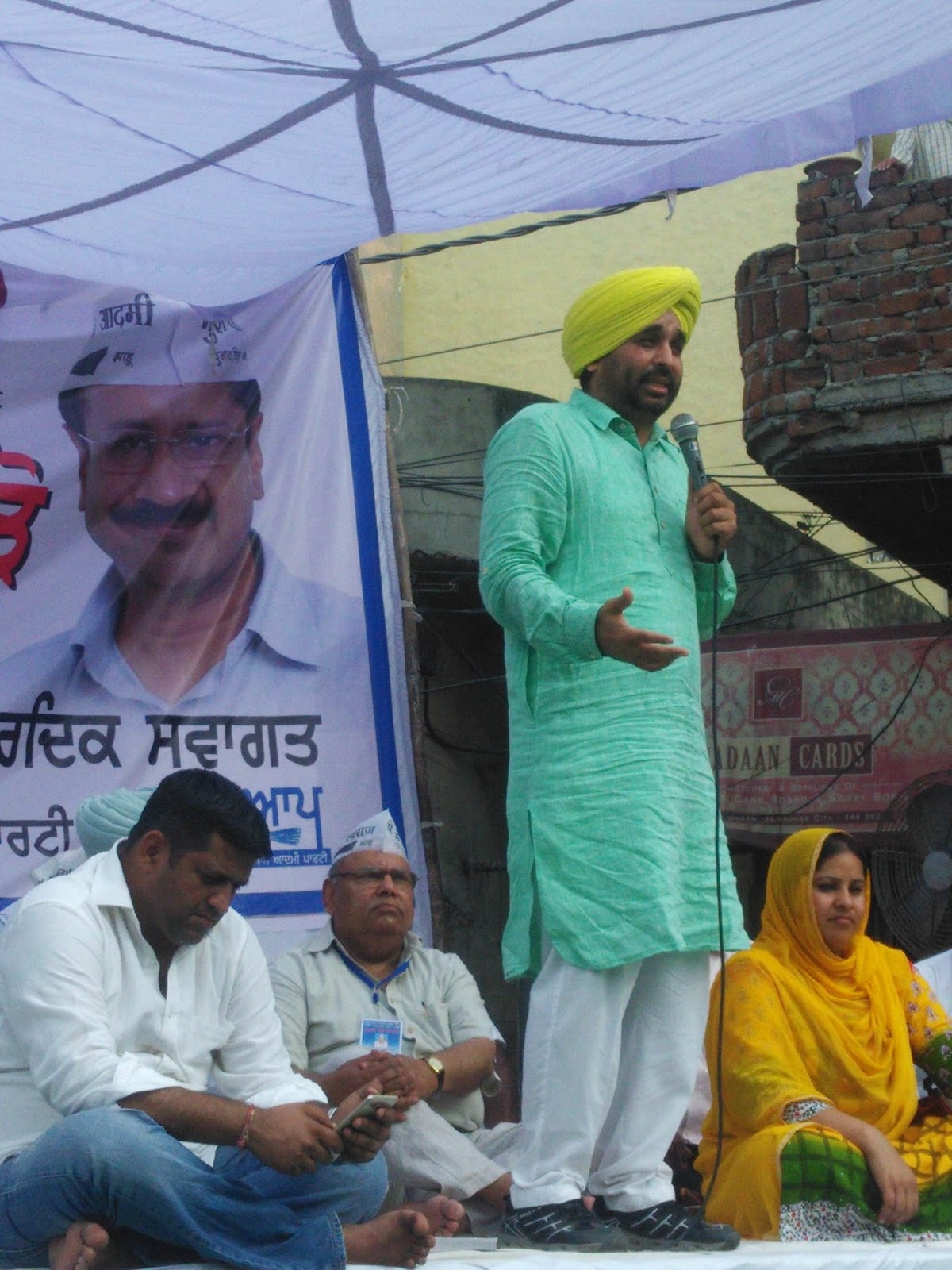
MP Bhagwant Mann addressing the Sabha

The Aam Aadmi Party (AAP) has arrived in Punjab and it is destined to reach at the first opportunity available in the timeline of the forthcoming elections in Punjab in early 2017. The recently held Jan Sabhas in all the three regions, Majha, Malwa and Doaba, have clearly indicated the mood of the people and have confirmed the findings of the surveys and opinion polls conducted by the expert agencies. People are for change as they stand fed up of the ruling Akali-BJP elite and equally of the runners up and the so called alternative, the Congress Party. Both these groups have lost the confidence and support of the people of Punjab at large. The AAP leadership under the stewardship of Arvind Kejriwal is fully charged and involved in bringing about the much needed ‘Parivartan’ as visualized by our leader Arvind Kejriwal. Through these well organized and attended Jan Sabhas, MPs Bhagwant Mann and Sadhu Singh supported and accompanied by, inter alia, Convener of the AAP in Punjab Sucha Singh Chhottepur, Central Observer Sanjay Singh, star campaigners like Gurpreet Ghuggi, Sukhpal Singh Khaira, Santokh Singh Salana and others have raised the curtain of the upcoming events and scenario on the political firmament of Punjab in the coming months. It seems that Punjab is all set for almost a clean sweep by the AAP.

I am also a small cog in the AAP wheel. I contributed my humble
Ramesh Chander adressing the Sabha
bit to the Jan Sabha on April 3 at Basti Guzan on advice and consultation with our political guides, Rajiv Chaudhary, Dr. H.S. Cheema and Sunil Dutt. It is a matter of satisfaction that the Sabha, which was addressed by MP Bhagwant Mann and Santokh Singh Salana, was a great success. The audience listened to the AAP leaders with rapt attention and interest. I was also invited to speak briefly at the Sabha. It was my first speech from a political platform after joining the AAP in the last week of February, 2016. After living a 35 years long career of a faceless diplomat, it was a new but pleasant experience. I was full of emotions. I had my schooling in the area at the Sain Dass School at Basti Nau. I used to roam around in shorts and knickers in Basti Guzan for cost effective stationery and old books from the make shift ‘Kishoo di Hatti’ located under the huge and old banyan tree at the big round about near the Adda Basti Guzan, the venue of the Jan Sabha. After my education, I enjoyed and relished the fruits of Indian Foreign Service (IFS), one of the coveted services of India. Now from the same venue, I was starting my political life to serve the people and society to pay back the debt of gratitude, I owe to them. I could not control myself and expressed my feelings in a charged and choked voice at the Sabha. I am confident that I will get the due public support in the noble task.

With this, I rededicate myself to work hard under the banner of the AAP to realize the vision of our leader Arvind Kejriwal to give power to the people to transform our political democracy into socio-economic democracy as visualized and stipulated by our fore fathers, particularly my idle and icon Babasaheb Dr. B.R. Ambedkar.

यह राहें ले ही जांएगी, मंजिल तक, हौसला रख;

कभी सुना है ? अँधेरे ने सवेरा न होने दिया !