Monday, October 29, 2012

GURDASS RAM ALAM – A TRIBUTE


Today (October 29) is the centenary of ‘Peoples Poet’ Gurdas Ram Alam (1912-1989), was a genius but an embodiment of simplicity and humility. His bio-profile is nothing but poetry of total transformation in the society. I am not a literary critique and may not know the nuances of fine poetry. But the poetry of Alam, to a layman like me, is the language of the poor. It is the spirit of the down-trodden. It speaks of equality. It pleads for a just and equitable social and economic order. Alam was not educated in the formal sense of scholastic classes. He barely learnt the Punjabi language at home but Alam was a born intellectual. His poetry amply confirms this. Alam could easily be compared with Shiv Kumar Balalvi, Pash, Mohan Singh, and Amrita Pritam, all in one. People termed him a communist when he gave an easy Punjabi expression to the theory of Marx “to each according to his need and from each according to his capacity” and wrote “asin bit to waddu dinden han; sanu lod mutabik milda nahin “. Alam became an Ambedkarite when he recited his poem “ ajj kaon ayia savere savere “ in a public meeting in the presence of Dr. B.R. Ambedkar in 1952 at Bootan Mandi in Jalandhar.  He wrote about Guru Ravidass in his poem ‘Inqalabi Aaggu’. Alam wrote about Guru Nanak in his poem ‘Patni da Gilla’. He wrote about contemporary politics. Alam gave an altogether new idiom to romance and love when he wrote “mahi mera kale rang da behde badda ta chand chad janda “.  Alam did not know any boundary and practiced the art of poetry for the common good of the society without any dogma of theory and ideology as a universal humanist.

I am fortunate that I met Alam and listened to his poetry from his mouth way back for several years in late 60s in Kavi Darbars in Bootan Mandi in Jalandhar on the Gurupurab of Guru Ravidass. Later I read his poetry books and carried them with me abroad in course of my diplomatic assignments. His poetry is as relevant today as it was before. In recent years, I heard lot about Alam in Glasgow in Scotland when I was the Consul General of India in Edinburgh. He enthralled the audiences in Glasgow when he visited there with Shiv Kumar Batalvi. My admiration for Alam goes higher and higher as the years go by.

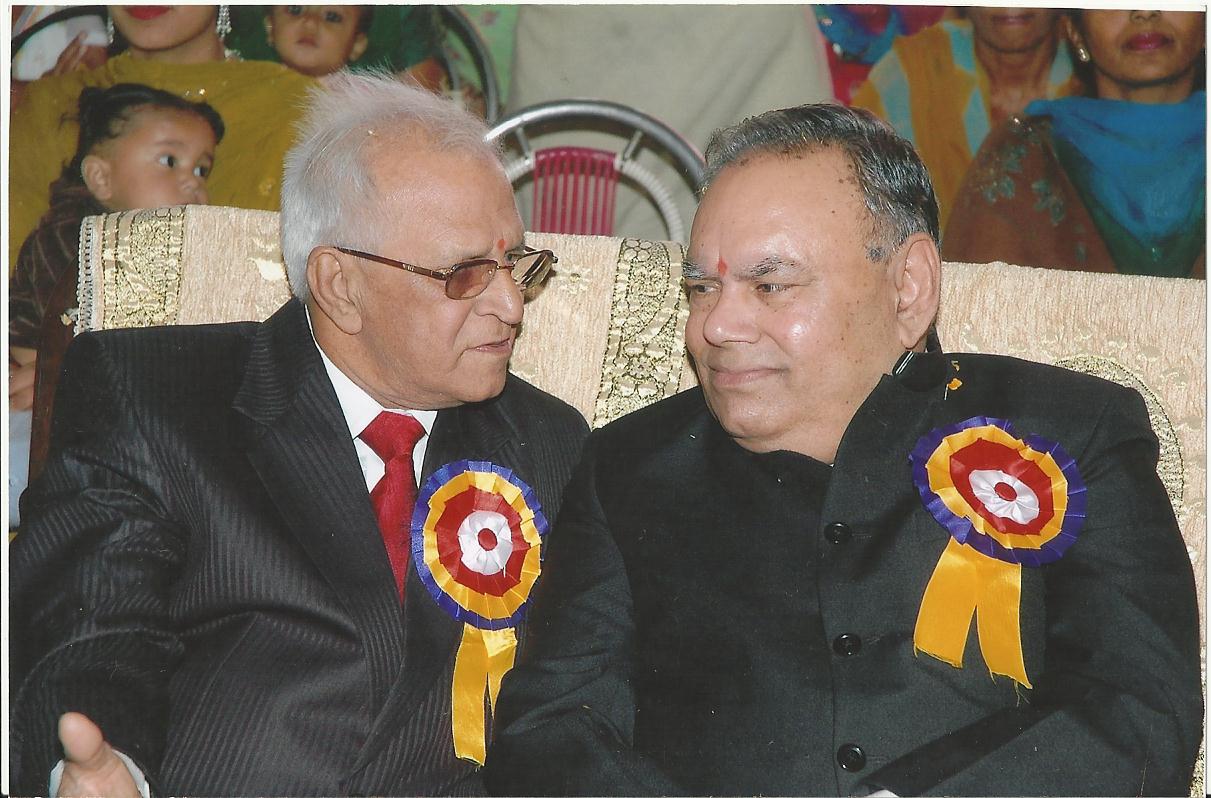
 My senior colleague Ambassador Bal Anand prompted me to participate in a function to commemorate Gurdass Ram Alam on October 28 at Jalandhar by Manavwadi Rachna Manch. It was a rewarding attendance. It provided me an opportunity to listen to intellectual poets and scholars who spoke high of Alam and rightly so. The Manch conferred “Gurdass Ram Alam Award” on a recognized poet of Alam's genre, Madan Veera. The function succeeded in paying well deserved tributes to Gurdass Ram Alam on his centenary. Alam and his poetry will remain alive in the years to come.

Monday, October 15, 2012

MY DEAR LALLY


I am writing this with a great sense of sorrow and a heavy heart. Lalit Angural (Lally), a hale and hearty young man, passed away suddenly in the forenoon of October 6, 2012 with a silent heart stroke. He was to complete 24 on October 9. Lally’s sister Sulekha is our daughter in law, wife of my son Rupesh. But the parents of Lally, Madan and Nimmo, are our family friends of long standing. Madan is a business partner of my brother Kishan and Lally was a business associate of Kishan’s son Brijesh (Bablu).  Lally, as such, was a part of our own family in all respects. Even after, our family friendship turned into close relationship, Lally continued to call us Tayaji and Taiji. The untimely and sudden death of Lally cut down a promising and budding businessman, a great hope and stay of a struggling family to find their feet in the society. The cruel hands of death have snatched that dream and hope. I was in Gurgaon for a few days to be with Sulekha and our little granddaughter Suhani (3 yrs.) as Rupesh was away to Russia on a business trip when the sad news reached us. I brought Sulekha and Suhani to Jalandhar in the night of October 6 itself. It was one of the difficult journeys of my life, Sulekha weeping and crying and Suhani getting curious and sad throughout.

On reaching Madan’s home, the scenario was totally unbearable. The dead body of Lally was kept in a refrigerated box for cremation the next day, October 7. It looked as if he was in a deep sleep. For me it was a different experience. By the quirk of fate or by chance, I did not see death/dead body even at this ripe age of 60 plus. My grandfather died of heart attack in 1972. I could not reach Jalandhar from Delhi before the cremation. My father in law died in 1979. We were in Beijing (China) and could not reach for the rituals. My father died in 1986 after a long illness and we remained with him for a month or so a months before his death. But we could not reach home at the time of death. We were in Kandy (Sri Lanka). My grandmother died in 1990. Again we could reach Jalandhar only after the cremation. My mother died in 2006 after a prolonged illness. We were in Prague (Czech Republic). We could not reach. The reasons for this unintentional absence were partly exigencies of service and partly my non-insistence to wait for me for the rituals. As a simple and ordinary human being, I have tried and lived life as it came. My brothers have been very supportive and respectful. So far so good.

Lally’s death was a shattering experience. I find it difficult to forget his lovely face and charming behavior. Lally was good at studies. After BBA, he was doing MBA from Sikkim Manipal University. He was fully and successfully engaged in a good export business as a self made person. He was a man in a hurry to do many things quickly. He was a social and amicable personality who was engaged in social and extra-curricular activities. It will be difficult to fill the void created by Lally’s sudden departure in the years to come.  May God grant peace to the departed soul of Lally.


Tuesday, October 9, 2012

BABU KANSHI RAM – A TRIBUTE


Today, October 9, is the death anniversary of Babu Kanshi Ram (March 1934-October 2006) who was also addressed with respect as “Manyawar” by his followers and rightly so. Babu Kanshi Ram was a great leader of the dalits and other backward and weaker sections of the society after Dr. B.R. Ambedkar. He carried forward the Mission of Joytiba Phule and Ambedkar with great zeal and resultant success. In fact, to my mind, it was Kanshi Ram who could generate and provide a mass base for the dalit movement and aspirations in the contemporary India. He succeeded in encouraging and motivating the dalit youth to stand up and ask for their rightful space and position in the political, economic and social establishments of the polity, economy and society of the country.  He fought for total transformation as against the status quo of the political and social forces at the helm of the affairs. Babu Kanshi Ran in one of his interviews to the media in the early years of his political career said” To my mind, all parties represent the forces of status quo. For us, politics is the politics of transformation. The existing parties are the reason for the status quo. That is why there has been no upward mobility for the backward communities”.

In the early years of his life, Babu Kanshi Ram was a scientist working with a Government scientific laboratory in Kirkee.  Some routine cases of upper-caste high handedness cajoled the sensitive mind of Kanshi Ram. He studied Ambedkar’s writings and embarked upon a mission for the empowerment of the dalits and other backward classes as equal partners in the political and economic structures of the country.  Kanshi Ram launched his first organization called BAMCEF (Backward (SC, ST, OBC) and Minority Communities' Employees' Federation) on December 6, 1978:  Three years later, on December 6 1981, he founded another organization called DS-4 (Dalit Shoshit Samaj Sangharsh Samiti) and on April 14, 1984, i Kanshi Ram finally formed a political party named Bahujan Samaj Party. Babu Kanshi Ram was a visionary. He was an astute political strategist and a communicator par excellence.

Kanshi Ram disapproved the current dalit leadership and termed them as Chamchas created by the Poona Pact of 1932 signed between Mahtma Gandhi and Dr. Ambedkar. He criticized the Poona Pact as it took away separate electorates offered in the communal award of PM Ramsey MacDonald which, according to Kanshi Ram, was a political blunder and tactful defeat of dalits by the Manuwadi forces.

Kanshi Ram’s political vision and his success are clearly visible in the emerging India. BSP is one of the leading political parties of the country. His follower Kumari Maywati occupied the coveted position of the Chief Minister of UP for four terms. The party has an impressive strength in the Parliament and the UP Legislature. BSP is a political force to be reckoned with.  Dalits are getting assertive for their rights and dues. It is all due to the relentless struggle of Babu Kanshi Ram. The contours of the Indian political and social order are changing. I am reminded of Kanshi Ram’s thinking when he said “I tell my followers Ek Eet Ka Jawab, Do Pathron Se (you must retaliate for one brick with two stones), otherwise you are not my followers”.
ऐ खाक नासिनों उठ बैठो वोह वक़्त मुकाबिल आ पहुंचा,
जब तखत गिराएं जांएगे और ताज उछाले जांएगे ! 

Monday, September 24, 2012

BEGUMPUR INTERNATIONAL CENTRE OF SPIRITUAL AND HUMAN EXCELLENCE


I wrote about Swami Gurdip Giri of Pathankot in this blog. Swami Gurdip Giri added yet another feather in his turban yesterday, September 23, 2012. He facilitated, negotiated and signed an MOU between Dera Swami Jagat Giri Charitable Trust of Pathankot and Manav Samta Sthal Charitable Society of Delhi for the establishment of an educational and knowledge complex – Begumpura International Centre of Spiritual and Human Excellence.  The Centre is to be set up at a 70 acre venue at village Hara Tika, Dhar Block of District Pathankot on Dalhousie Road which has been ear marked and offered by Swami Gurdip Giri for the purpose. The main objective of the Begumpura Centre of Spiritual and Human Excellence is to develop and provide facilities for an overall development of the downtrodden and under privileged sections of the society.  I participated in the meeting to conclude and sign the MOU at Pathankot as a special invitee of Swami Gurdip Giri which was an honour for me. Blessing the MOU, Swami Gurdip Giri underlined the need to creat and offer excellent facilities for the weaker sections of the society not only spiritually but also in all other facets of human development. He said that t will be a true tribute to the great Guru Ravidassji and also the contemporary messiah of the dalits, Dr. B.R. Ambedkar.

The senior representatives of Swami Jagat Giri Charitable Trust and Manav Samta Sthal Charitable Society including Shri R.L. Pradeep, IAS (Retired), Shri J.S. Badhan IAS (Retired), Shri B.R. Kundal, EX.Minister, MLC and Chief Secretary of J&K (Retired), Shri Banal, DGP of J&K (Retired) Shri F.C. Mall, Deputy Director of MHA (Retired) inter alia participated and signed the MOU in the presence of Swami Gurdip Giri.  The foundation stone of the Begumpura Centre of Spiritual and Human Excellence is like to be laid towards the close of the current year.

I wish Begumpura Centre of Spiritual and Human Excellence all success and further prosperity and good health to Swami Gurdip Giri.
जरा सी नम  हो तो यह मिटटी बड़ी जरखेज है साकी ! 

THE POONA PACT of 1932 and DALIT EMPOWERMENT


The anniversary of the Poona Pact of 1932, signed between Mahatma Gandhi and Dr. B.R. Ambedkar, falls on September 24.  Much water has flown in the Ganges in the last 80 years since the Poona Pact was signed but the condition and the fare of the dalits in India did not change much for the better, in spite of legal and constitutional provisions made even in the constitution of India.  The much needed empowerment of dalits remains an issue even after 65 years of independence.  Let us analyze the subsequent developments, after the Poona Pact, which have directly or indirectly affected the empowerment of dalits which was the sole purpose of the Pact.

It is known history that Dr. B.R. Ambedkar’s intense struggle against the British rulers and the Indian society and its leaders resulted in recognizing for the first time the political rights of dalits in the Communal Award of 1932 given by PM Ramsay MacDonald after the debates and decisions of the Round Table Conferences. Like other communities, dalits were also given separate electorates to send their representatives to the central and provincial assemblies. With this the political and social identity of the dalits got established.  The Hindu society and its leaders led by Mahatma Gandhi were dead against this happening. The manuwadi mindset was at work. They were not interested in the empowerment of the dalits but wanted to keep the dalit community in their fold to serve them as dictated in the scriptures. The ‘oligarchy of the high castes’, as somebody has said, was the riding consideration of the society rather than addressing the problems of caste and untouchability. Mahatma Gandhi termed the Communal Award 0f Ramsay MacDonald as “injection of a poison is calculated to destroy Hinduism and do no good whatever”. . Gandhi strongly opposed the communal award on the grounds that it would disintegrate Hindu society. He began an indefinite hunger strike from September 20, 1932 to protest this award. In view of the mass upsurge generated in the country to save the life of Gandhi, and appeals of orthodox Hindu leaders, Congress politicians and activist, fearing a communal reprisal and genocide of untouchables, Dr. Ambedkar was compelled to soften his stand. He agreed to joint electorates under massive coercion from the supporters of Mahatma Gandhi.  As a result of the agreement, A compromise between the leaders of caste Hindu and the depressed classes was reached on September 24, 1932, popularly known as the Poona Pact signed in the Yerwada Jail where Mahatma Gandhi was on hunger strike. The resolution announced in a public meeting on September 25 in Bombay confirmed -" henceforth, amongst Hindus no one shall be regarded as an untouchable by reason of his birth and they will have the same rights in all the social institutions as the other Hindus have". This landmark resolution in the history of the Dalit movement in India subsequently formed the basis for giving due share to Dalits in the political empowerment of Indian people in a democratic Indian polity.

But it was not to be. Ambedkar and his followers were soon disillusioned. The provisions of separate electorate as envisaged by the communal award were enough to establish political and social identity of the dalits. The opportunity was cleverly denied by the Poona Pact. Ambedkar was disappointed and he made his disenchantment known to Mahatma Gandhi in his letter dated February 11, 1933 bluntly refusing to give a message for the inaugural issue of the Harijan“. . . I feel I cannot give a message. For I believe it will be a most unwarranted presumption on my part to suppose that I have sufficient worth in the eyes of the Hindus which would make them treat any message from me with respect . . . I am therefore sending you the accompanying statement for publication in your Harijan.”


Statement

“The Out-caste is a bye-product of the Caste system. There will be outcastes As long as there are castes. Nothing can emancipate the Out-castes except the destruction of the Caste system. Nothing can help save Hindus and ensure their survival in the coming struggle except the purging of the Hindu faith of this odious and vicious dogma.”


Dalits continue to suffer from this disability of having an identity till today.  Babu Manguram Mugowalia and his associates tried their best through the Ad-Dharam Movement to establish dalit identity by stating and pleading that dalits were neither Sikhs nor Hindus. Subsequently Babu Kanshi Ram also rose and disapproved the Poona Pact. He wrote in Preface of his book the Chamcha Age that Chamcha age started from the Poona Pact giving joint electorates instead of separate electorates. The purpose of book was to make Dalit Soshit Samaj of the existence of Chamchas or stooges, and to awaken masses how to differentiate between genuine and counterfeit leadership. The reservation issue is still alive as the dalits could not be empowered as desired. Moreover, the thinking of Mahtma Gandhi in saving the Hinduism has fallen flat otherwise also. Sikhs have asserted their separate identity independent of Hinduism. The Poona Pact it seems was an act of treachery and fraud on the dalits. The point is not to blame Dr. Ambedkar as he had no other option as he was a nationalist to the core. He did not want to create friction with the majority Hindus on one hand and stand against the national movement of independence against the British on the other.

 मस्जिद तो बना दी सब भर में; इमां की हरारत वालों ने,

मन अपना पुराना पापी है; बरसों से नमाज़ी बन सका !

इकबाल बड़ा उपदेशक है; मन बैटन से मोह लेता है,

गुफ्तार का तो यह गाजी बना; किरदार का गाजी बन सका!


Saturday, September 15, 2012

S.R. HEER of Dera Sachkhand Ballan


I have been writing about the contemporary dalit heroes in my blog. Let me carry forward the series with yet another hero, Shri Sadhu Ram Heer, Former Chief Engineer and Head of Jalandhar Doordarshan and currently Chief Aide of the Dera Sachkhand Ballan. I heard about Heer Sahib but as of now did not have the chance to meet and know him. It should not be an obstacle and would like to write and recognize him. The immediate provocation to do so was the 53rd anniversary of Doordarshan which was observed yesterday September 14 with a poetic symposium ( Kavi-Darbar) on DD Jalandhar at which S.R. Heer was the Chief Guest. I could learn more about Heer Sahib from the introduction given by the Master of Ceremonies and also the speech of the Director of DD Jalandhar. Both of them spoke highly of S.R. Heer and informed that his contribution to DD, not only in Amritsar and Jalandhar in the initial years of its operations but also its overall performance and success, was immense and appreciable. S.R. Heer was a pillar of strength of DD Jalandhar in making it number one station. It was duly recognized by the Government and rewarded. Heer Sahib spoke with conviction in his brief but impressive speech and said that the original mandate of DD was to ‘educate, inform and entertain’ which was the correct agenda and vision of the national TV network in spite of increasing commercialization and competition from the private TV channels. I did not know much about Heer Sahib till the Kabi-Darbar of September 14. The stock of S.R. Heer in my mind and estimation has gone up. I salute him as the worthy son of India and hero of the community.

I am told that S.R. Heer is a simple man of spiritual orientation. His post retirement association and engagement with Dera Schkhand Ballan and its activities is well established and recognized. I understand Heer Sahib is the main spokesman and the chief aide of the Dera and various trusts and other socio-religious and educational outfits run and managed by the Dera. As such, Dera being the hub of soico-religious upliftment of the community at large, contribution of Heer Sahib is praiseworthy and shall be commended.

 I take this opportunity to wish Heer Sahib good health and further success and prosperity.

Wednesday, September 5, 2012

THE TEACHERS DAY - SEPTEMBER


Toda September 5 is the Teachers Day which is observed on the birthday of the former President of India Sarvapalli Radhkrishnan.  The day is dedicated to the teachers keeping in with the lofty tradition of “Acharya Devo Bhav”. I feel like writing on this day almost regularly as I hold my teachers in high esteem and still keep in contact with some of them.  

I had my primary education in the community run school at Bootan Mandi, Jalandhar which was make shift arrangement in the Gurudawara. I will be failing in my duty if I don’t mention the name of Seth Khushi Ram who was the Head of the informal managing committee of the school. He did a good work in providing the basic educational facilities in and around Bootan Mandi. I pay my tributes to Seth Khushi Ram and his associates on the Teachers Day.  I will mention about a teacher whose ever smiling face is deeply ingrained in my memory. She was Sheila Behanji of a nearby mohalla Abadpura.  As I recall she almost a family member of ours and many more like me and participated in our “Dukh & Sukh” apart from teaching us in the school.  In the long summer holidays, we even used to go to her home for additional lessons.  She was a homely lady of dignity. I vividly remember that her husband was working in the Indian army. Today, my heart goes to Sheila Behnji.

 I graduated to the Sain Dass High School in Basti Nau which was considered a good school in the area at that time.  Headmaster Baldev Raj was a much respected personality in the area and was a good educational manager. I recall that his deputy was Dawarka Sass, a saintly figure. Apart teaching English he was engaged in imparting moral and spiritual knowledge.  I must admit that whatever little English I know today it is primarily because of Master Dawarka Dass and Master K.K. Khullar. I realized this much later when I used their notes in my college days. My humble tributes to my teachers at the Sain Dass School

After high school, I joined DAV College in 1966 and graduated (BA) in 1970. I was a mediocre. My main interest, as one of the subjects, was Political Science. I was much ahead of my contemporaries in general awareness which I think remained my one of the assets throughout my service in the IFS and daily life. I will like to remember today Principal BS Behl.  He was not my teacher as such but his administrative skills,  to make DAV College one of the premier educational institutions in north India,  impressed me a lot.  As I mentioned in one of my blogs earlier,  Prof. KC Mahendru and Prof. KK Ghai are two of my teachers of Political Science who contributed a great deal in shaping my personality and career. I have no claims to be brilliant student but my own interest in political science and general awareness, without even they knowing, made them dear to me.  It is my good fortune that, due to a kind gesture of my friend Ram Lal Kainth who reintroduced me to both Prof Mahendru and Prof Ghai, I am in touch with them even after my retirement from diplomatic career in IFS.  Both them are leading a retired but still active life in Jalandhar. My all the best wishes to Prof. KC Mahendru and Prof. KK Ghai for their good health and further success and prosperity in the years to come.

SALUTE TO THE TEACHERS OF INDIA